Hotel breakfast coffee has real influence. It is rarely the headline promise of a stay, yet it can decide how the morning feels: generous or careless, calm or rushed, memorable or merely functional. Guests may forgive a small room or a rainy view. A bitter first cup is harder to forget.
For specialty-coffee drinkers in the US, UK, EU, and Nordic markets, coffee expectations have changed. People have learned from third-wave cafés to ask where coffee comes from, when it was roasted, how it was brewed, and why one origin tastes different from another. That does not mean every hotel breakfast needs a slow-bar. It means the coffee should taste intentional.
Guatemalan coffee is a strong candidate. It can be sweet, structured, clean, and familiar enough for a broad breakfast crowd while still giving curious guests a real single-origin story. Used well, it turns hotel coffee from anonymous caffeine into a quiet signal of quality.
Quick answer: why choose Guatemalan coffee for hotel breakfast?
Guatemalan coffee works well for hotel breakfast because many lots combine chocolate-like sweetness, gentle fruit acidity, medium body, and a clean finish. Those qualities make it suitable for batch brew, insulated servers, breakfast food pairings, and guests who drink coffee black or with milk.
For hospitality teams, the advantage is practical: Guatemalan coffee is easy to describe without overselling. A staff member can say “single-origin Guatemalan coffee, roasted for sweetness and balance, with notes of cocoa, caramel, citrus, and red apple” and give guests a useful reason to care.
The market reality: guests notice origin now
Coffee is no longer just a purchasing line. CBI describes Europe as the world’s largest coffee-consuming market, accounting for 30.7% of global coffee consumption in 2023/2024, and connects value growth with premiumisation (CBI European coffee demand). Its specialty-coffee market analysis also highlights traceability, distinctive taste profiles, and origin storytelling as important signals in premium coffee segments (CBI specialty coffee market potential).
Translated into hotel language: many guests understand that coffee can be chosen, sourced, brewed, and explained. They may not want a technical conversation at 7:30 in the morning, but they can tell the difference between a flat buffet blend and a cup selected with care.
That is especially true in boutique hotels, destination lodges, conference properties, and independent restaurants with rooms. Guests may buy whole-bean coffee at home or use a subscription; generic breakfast coffee can feel out of step with the rest of the stay.
Guatemala helps hotels raise quality without making service fragile. It is not as polarising as a highly floral Ethiopian natural, not as sharply bright as some Kenyan coffees, and often more lifted than a classic low-acid Brazilian profile. Compared with Colombian coffee, it can feel similarly approachable but often adds a firmer cocoa-citrus structure for batch brew.
What “good hotel coffee” actually means
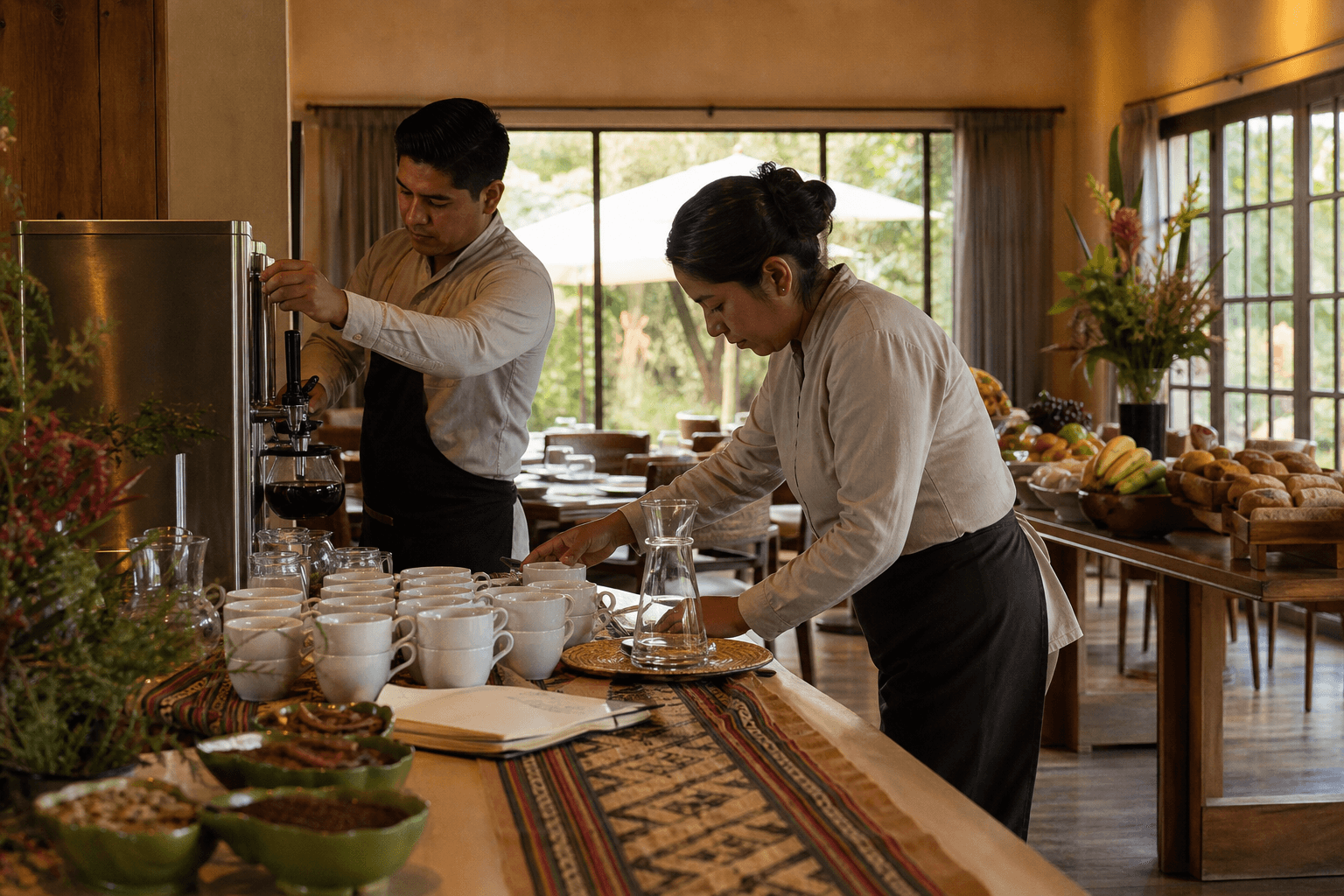
In a café, a barista can dial in one espresso, one pour-over, or one small batch at a time. At hotel breakfast, coffee has to survive a tougher reality:
- it must taste good across a two- or three-hour service window
- it must work for black coffee drinkers and milk users
- it must pair with fruit, bread, eggs, cheese, yoghurt, and pastries
- it must be easy for staff to brew consistently
- it must be simple to explain in one sentence
- it must feel premium without slowing down breakfast
This is why not every spectacular specialty coffee is the right hotel coffee. A delicate Ethiopian washed coffee with jasmine and bergamot may be beautiful in a porcelain cup at a slow bar, but it can taste thin beside eggs and sourdough. A very experimental anaerobic lot may excite coffee professionals but confuse guests who simply want a sweet, clean morning cup.
A good hotel breakfast coffee needs balance. In plain English, balance means no single feature shouts over the others. Acidity gives freshness, body gives comfort, sweetness makes the cup pleasant, and the finish should be clean.
Guatemalan coffee often sits in this useful middle. It can carry enough body for breakfast service while still giving recognisable specialty character: cocoa, caramel, orange, red apple, stone fruit, toasted nuts, and gentle spice.
Why Guatemala fits the hospitality brief
Guatemala is one of Central America’s most useful origins for explaining coffee clearly. Guatemalan Coffees, the origin platform associated with Anacafé, describes regional profiles including Antigua Coffee, Highland Huehue, Acatenango Valley, Traditional Atitlán, Rainforest Cobán, Fraijanes Plateau, New Oriente, and Volcanic San Marcos, and notes how growing conditions shape cup character (Guatemalan Coffees regions and profiles).
For a hotel, that diversity creates options. Antigua can suggest cocoa, spice, and structure. Huehuetenango may bring brighter citrus and fruit lift. The exact cup depends on producer, process, roast, freshness, and brew method, but the origin gives staff a concrete story to work with.
This matters because “specialty coffee” can sound vague to guests. Single-origin Guatemalan coffee is more specific. It tells the guest that the coffee is not an anonymous blend, and that the hotel has chosen a cup profile rather than simply buying whatever was cheapest.
Direct trade coffee can strengthen that story when it is real. Direct trade is not a protected certification, so it should not be used as a magic label. In practical terms, it usually points to closer buyer-producer relationships and better traceability than commodity-style sourcing. If your hotel, café, or breakfast room wants a coffee story that feels credible, Guatemala gives you enough origin detail to make the story useful rather than decorative.
A batch brew recipe for breakfast service
Batch brew is often the right format for hotel breakfast because it gives speed, consistency, and low-friction service.
Use this as a starting point for a medium-roasted Guatemalan coffee:
Swipe the table sideways to see all columns.
| Service variable | Starting point | Why it helps |
|---|---|---|
| Coffee dose | 60 g per litre | A balanced specialty baseline for batch brew |
| Water | Filtered, clean-tasting | Reduces chlorine, scale, and flatness |
| Grind | Medium-coarse | Helps sweetness without harshness |
| Brew target | 5–6 minutes total contact | Enough extraction for body and clarity |
| Holding time | Best within 45–60 minutes | Keeps sweetness before the cup turns stale |
| Server routine | Rinse and preheat before brewing | Protects temperature and avoids old-coffee flavours |
The Specialty Coffee Association publishes standards and resources that give the industry shared language around brewing, cupping, and evaluation (SCA coffee standards). A hotel does not need to turn breakfast into a lab, but the same principle applies: measure, taste, and adjust deliberately.
If the coffee tastes thin, increase extraction before increasing roast darkness. Grind finer, check water temperature, and confirm the dose. If it tastes bitter or dry, grind coarser, shorten the hold time, clean the brewer, and check whether old coffee is sitting in the server too long.
The simplest service improvement is also the least glamorous: never top up old residue with today’s brew. Clean servers make better coffee.
The breakfast pairing advantage
Breakfast is not dessert. Coffee has to work with fat, salt, fruit, grain, dairy, and sweetness at the same table. This is where Guatemalan coffee can be more versatile than it first appears.
Swipe the table sideways to see all columns.
| Breakfast item | What to look for in the coffee | Why Guatemala can work |
|---|---|---|
| Croissants, brioche, pancakes | Caramel, cocoa, brown sugar | Sweetness echoes butter and toasted pastry |
| Eggs, avocado, mushrooms | Clean acidity, medium body | Freshness cuts richness without tasting sharp |
| Yoghurt, granola, berries | Apple, citrus, stone fruit | Fruit notes connect with lighter breakfast bowls |
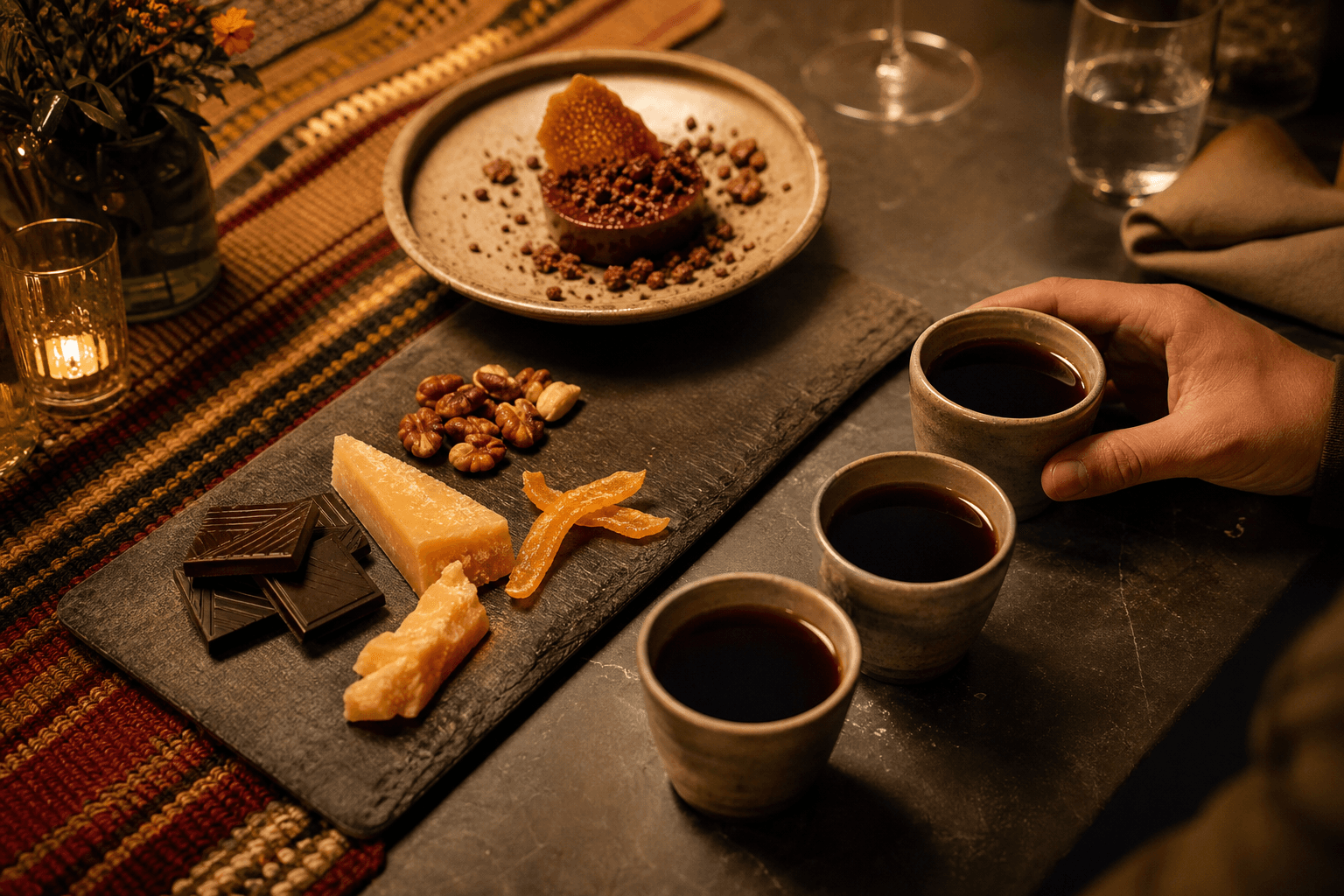
| Cheese, ham, smoked fish | Structure, nut, cocoa, clean finish | Enough depth for savoury food without heaviness |
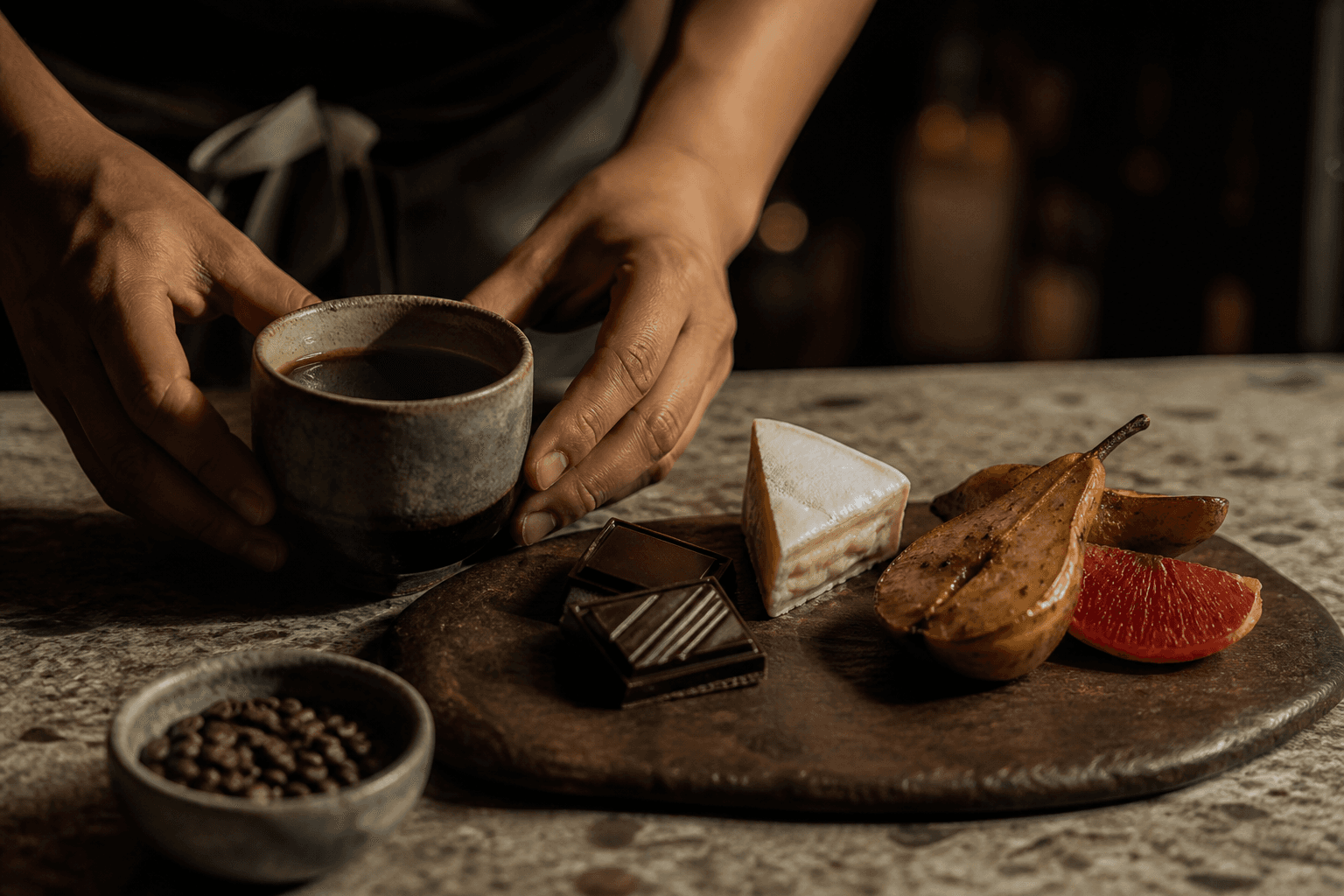
| Dark chocolate or sweet bakery | Cocoa, spice, orange | Feels premium without needing syrup |
Compared with Kenyan coffee, Guatemalan coffee often feels less intensely blackcurrant-like and easier to pair with savoury food. Compared with Ethiopian coffee, it is usually less floral and more grounded, which can help when guests add milk or eat a full breakfast. Compared with Brazil, it often brings more acidity and origin definition while keeping enough morning comfort.
That does not make Guatemala “better” than those origins. It makes it strategically useful for hospitality: broad enough for the room, specific enough for the guest who asks.
How staff should talk about it
The best coffee language for hotel breakfast is short, human, and confident. Avoid tasting-note poetry if the guest has not asked for it. Avoid saying “it is acidic” without explanation, because many guests hear “sour.”
Try this three-level approach.
One sentence for every guest: “Today we’re serving a single-origin Guatemalan coffee roasted for a sweet, balanced breakfast cup.”
A little more detail for curious guests: “It has a cocoa and caramel base with gentle citrus or red-apple brightness, so it works black or with milk.”
A fuller explanation for enthusiasts: “Guatemala has distinct coffee regions, and this style gives us what we want for batch brew: sweetness, medium body, clear acidity, and a clean finish.”
This kind of language fits international specialty culture without making breakfast feel like a class. It tells guests that the coffee has been chosen, but it keeps the focus on hospitality.
If your team wants more origin vocabulary, Kapalaj’s guide to Guatemala coffee regions is a useful starting point. For the sourcing story behind the cup, the Kapalaj origin page gives a clearer sense of why Guatemala sits at the centre of our work.
A practical buying checklist for hotels and breakfast rooms
Before choosing a Guatemalan coffee for breakfast service, ask these questions:
- Does it taste sweet black? If the coffee only works with milk, it may not be the right breakfast anchor.
- Does it hold up for 45 minutes? Taste the first cup and the cup after service holding. Some coffees collapse quickly.
- Can staff describe it in one sentence? If not, simplify the positioning.
- Is the roast date and supply rhythm reliable? Breakfast coffee needs consistency, not only one impressive sample.
- Does the supplier understand batch brew? A beautiful espresso roast may not suit a hotel brewer.
- Is the origin story traceable enough to be credible? Country alone is a start; region, producer relationship, or sourcing model is better.
- Does it fit the menu? A coffee for croissants may not be the same as a coffee for a savoury Nordic-style breakfast board.
For hotels, offices, restaurants, and cafés, coffee buying is about repeatability. The best Guatemalan coffee for hospitality is the one that guests enjoy, staff can brew, and managers can reorder with confidence.
When not to choose Guatemalan coffee
No origin solves every problem. If a hotel wants an ultra-low-acid, chocolate-heavy cup with very little fruit character, a Brazilian or Brazil-led blend may be easier. If the breakfast concept is built around aromatic, tea-like filter coffee, a washed Ethiopian lot may be more dramatic. If the goal is an experimental coffee flight for enthusiasts, use multiple origins rather than one breakfast workhorse.
Guatemalan coffee is strongest when the brief is balanced: premium but accessible, origin-led but not fussy, sweet enough for repeat cups, and structured enough to taste considered in a busy service setting.
That is why it suits many modern hospitality spaces. It gives the hotel a story, the brewer a recipe, the staff a sentence, and the guest a better first cup.
FAQ: Guatemalan coffee for hotel breakfast
Is Guatemalan coffee good for batch brew?
Yes. Many Guatemalan coffees work well as batch brew because they combine sweetness, medium body, and clean acidity. Start around 60 g per litre, use clean filtered water, and serve within about an hour for the best flavour.
What does Guatemalan coffee taste like at breakfast?
Common cup notes include cocoa, caramel, orange, red apple, stone fruit, toasted nuts, and gentle spice. The exact flavour depends on region, process, roast, and brew recipe.
Should hotels serve single-origin coffee or blends?
Both can work. A blend may offer consistency across seasons, while single-origin coffee gives a clearer story and stronger origin identity. Single-origin Guatemalan coffee is a good option when the hotel wants traceability and approachable specialty flavour.
Can Guatemalan coffee work with milk at breakfast?
Yes, especially when roasted for sweetness and balance. Cocoa, caramel, nut, and soft fruit notes can stay pleasant with milk, while the coffee still tastes clean when served black.
How should staff describe Guatemalan coffee to guests?
Keep it simple: “single-origin Guatemalan coffee, roasted for a sweet and balanced breakfast cup.” Add notes like cocoa, caramel, citrus, or red apple only when guests ask for more detail.
Make the first cup part of the stay
A hotel breakfast does not need coffee theatre to feel special. It needs a cup that tastes like someone cared before the guest arrived. Guatemalan coffee gives hospitality teams a practical way to serve sweetness, balance, traceability, and origin character at scale.
If you are choosing coffee for a hotel, café, office, or breakfast service, contact Kapalaj to explore Guatemalan coffees selected for clean brewing, credible origin stories, and cups your guests will remember.