The moka pot deserves better than its reputation for fierce, smoky coffee. In many kitchens it is loaded with very dark grounds, placed over high heat, and left there until it spits like a tiny locomotive. The result is certainly strong. It is not always kind.
Handled differently, this stovetop brewer can show Guatemalan coffee’s cocoa depth, fruit brightness, gentle spice, and body. You need a suitable coffee, a level basket, restrained heat, and the confidence to stop before the last angry sputter.
Here is how to keep its origin character out of burnt bitterness.
Quick answer: how do you brew Guatemalan coffee in a moka pot?
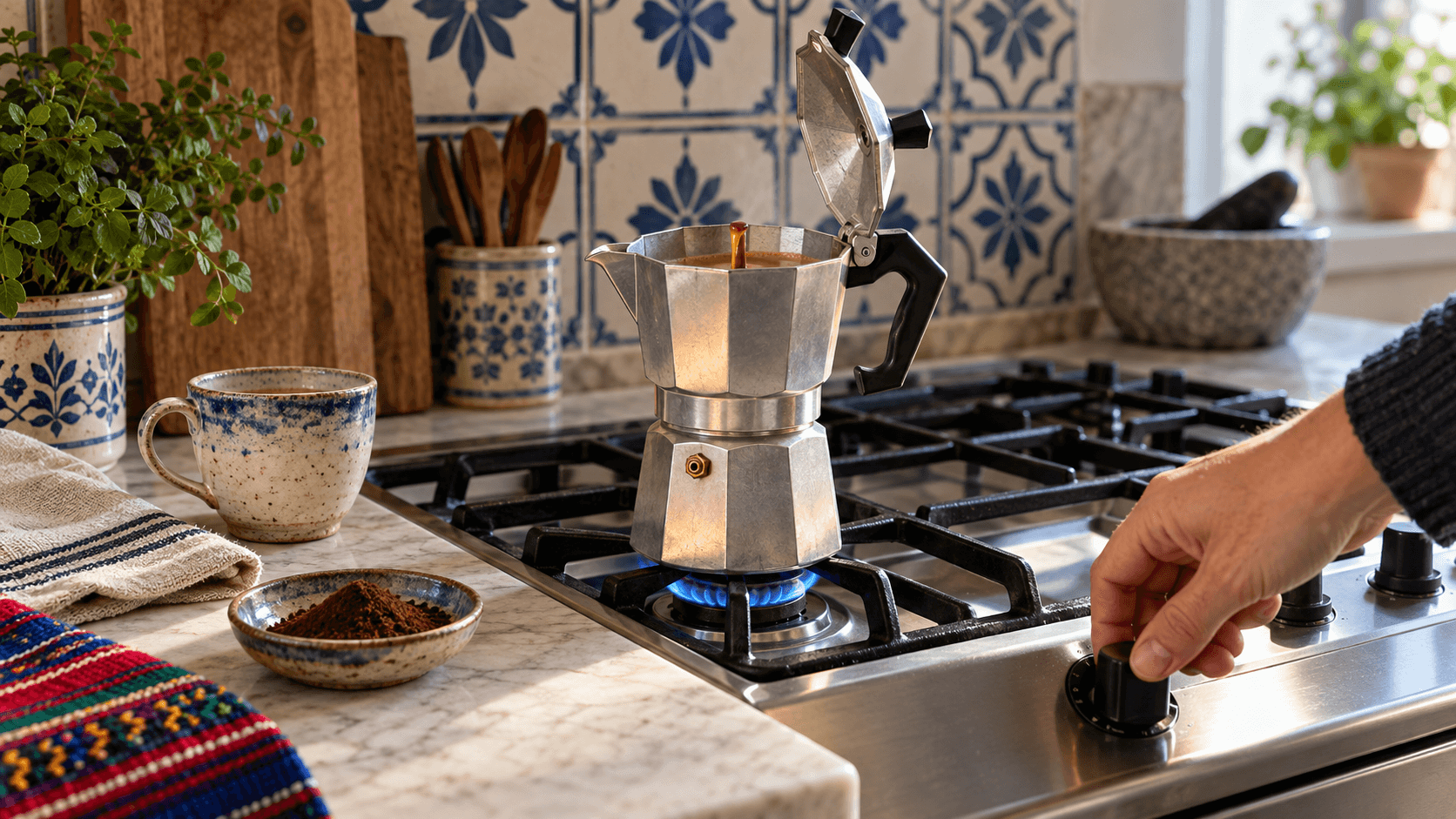
Fill the lower chamber with water to just below the safety valve. Add medium-fine ground coffee to the basket, level it gently without tamping, assemble the moka pot, and brew over low to medium-low heat. Remove it from the stove when the stream turns pale and begins to gurgle, then cool the base briefly to stop extraction.
For a sweeter cup, choose a light-medium to medium roasted Guatemalan coffee with notes such as cocoa, caramel, orange, red apple, nuts, brown sugar, or soft spice. A moka pot makes concentrated coffee, not true café espresso, so taste it neat first and then dilute with hot water or add milk if you prefer.
Why the moka pot belongs in specialty coffee
Specialty coffee is often photographed with a gooseneck kettle and a paper filter. That is only one version of good home brewing. Across Europe, Latin America, and international households, the moka pot is part of ordinary coffee life: compact, durable, and able to make a concentrated brew without a large machine. The opportunity is not to turn it into a pour-over, but to make that concentration taste cleaner and sweeter.
European coffee demand increasingly includes premium, differentiated coffee rather than only higher volume, according to CBI’s overview of the European coffee market. That shift is visible at home as much as in cafés. People want to know where their beans came from and why one roast works better than another, but they still need brewing advice that fits the equipment already in the cupboard.
The moka pot fits that reality. It rewards fresh beans, consistent grinding, clean equipment, controlled heat, and adjustment by taste.
Why Guatemalan coffee works so well in a moka pot
A moka pot concentrates flavour, making sweetness denser and roast bitterness harder to ignore. The coffee therefore needs both structure and clarity.
Guatemalan coffee often has that useful middle ground. Guatemala is not one fixed flavour profile: Guatemalan Coffees / Anacafé presents eight regional profiles shaped by different varieties, microclimates, elevations, soils, and growing conditions. One lot may lean toward cocoa and spice; another may show citrus, apple, stone fruit, florals, or red fruit.
In a moka pot, cocoa can become dark chocolate, caramel can become toasted sugar, and orange can become orange peel. Compared with many Ethiopian coffees, Guatemala is often less tea-like; compared with classic Kenyan profiles, less sharply bright; and compared with many Brazilian coffees, more acidic and regionally defined. Colombian coffee may occupy a similar comfort zone, while Guatemala often adds a cocoa-citrus or spice structure that holds up in a short cup.
These are useful tendencies, not guarantees. Producer, process, roast, freshness, water, grinder, and technique still decide what reaches the cup.
Choose the roast before you blame the brewer
The moka pot is often paired automatically with very dark roast. That creates body and familiarity, but it can also make every origin taste smoky, bitter, and interchangeable.
For origin-led moka-pot coffee, start with a light-medium or medium roast. You want enough development for the coffee to dissolve easily under a short, concentrated brew, but not so much that roast flavour covers the Guatemalan character.
Use the bag as a clue:
Swipe the table sideways to see all columns.
| If the label says... | Likely moka-pot direction | Who it suits |
|---|---|---|
| Cocoa, caramel, almond, brown sugar | Round, sweet, classic and milk-friendly | First-time specialty moka-pot brewers |
| Orange, red apple, stone fruit, honey | Brighter, cleaner and more origin-led | Black-coffee drinkers |
| Dark chocolate, spice, dried fruit | Deeper and more intense | Short cups and after-dinner coffee |
| Jasmine, lemon, tea-like | Potentially delicate or sharp at high concentration | Experienced brewers willing to adjust |
| Smoke, char, very dark roast | Heavy body with less regional detail | Drinkers who prefer roast flavour |
Our guide to how roast profile changes Guatemalan coffee goes deeper into the difference between filter and espresso-focused roasting. The same buying skill matters here: choose the coffee for the cup you actually want.
The Kapalaj moka-pot method
Moka pots come in different sizes, and their baskets are designed to be filled rather than half-dosed like an espresso basket. For that reason, a universal gram recipe is less useful than a repeatable fill method.
A reliable moka-pot sequence keeps water below the safety valve, fills the funnel without pressing, and uses gentle heat. Here is the specialty-coffee version, with extra attention to flavour.
What you need
- A clean moka pot with an intact gasket and clear safety valve
- Fresh Guatemalan coffee
- A burr grinder if available
- Fresh, clean-tasting water
- A low to medium-low heat source
- A folded towel or cool surface for stopping the brew
Step by step
- Add water below the valve. Fill the lower chamber until the water sits just beneath the safety valve. Do not cover it.
- Grind medium-fine. Aim finer than most filter coffee but coarser than espresso. The grounds should feel like fine table salt, not powder.
- Fill and level the basket. Add coffee until the basket is full, then level the surface gently. Do not tamp. A compressed puck can restrict flow and make the brewer behave unpredictably.
- Clean the rim. Brush away loose grounds so the seal can close properly.
- Assemble carefully. Screw the chambers together firmly without forcing them. If you used hot water, hold the base with a towel.
- Use restrained heat. Place the moka pot over low to medium-low heat. Keep the handle away from the flame.
- Watch the flow. Open the lid only if you can do so safely. Coffee should emerge in a steady, controlled stream, not explode upward.
- Stop before the harsh finish. When the stream becomes pale and starts to gurgle, remove the brewer from heat. Briefly place the base on a cool damp towel or run only the outside of the lower chamber under cool water.
- Stir and serve. Stir the coffee in the upper chamber before pouring. The first and last parts of the brew can differ in strength, so mixing gives each cup a more balanced result.
The Specialty Coffee Association’s standards work gives professionals shared language for brewing and evaluation. At home, the useful lesson is simple: keep the variables consistent, taste the result, and change one thing at a time.
The heat mistake that makes moka-pot coffee taste burnt
The moka pot does not need aggressive heat. High heat can make the final phase violent, while prolonged sputtering sends more steam and overheated water through an already-extracted bed. That is where many cups pick up their harshest edge.
Low heat is not about making the ritual slow for its own sake. It gives you control. You can see or hear the transition from a smooth stream to a pale, bubbly finish and remove the brewer before the final extraction dominates the cup.
Starting-water temperature is less important than avoiding excessive heat and stopping the brew deliberately.
Troubleshooting: fix the cup by taste
Swipe the table sideways to see all columns.
| What you taste | Likely cause | What to change next time |
|---|---|---|
| Sharp, sour, thin | Grind too coarse, flow too fast, or roast too light for the method | Grind slightly finer or use a more developed roast |
| Bitter and dry | Grind too fine, heat too high, or brew stopped too late | Grind slightly coarser, lower the heat, stop at first gurgle |
| Burnt or smoky | Very dark roast, dirty pot, or prolonged high heat | Clean thoroughly, choose a lighter roast, reduce heat |
| Weak but clean | Basket underfilled, grind too coarse, or brew diluted too far | Fill the basket level and grind slightly finer |
| Metallic or stale | Residue, damaged gasket, old coffee, or poor water | Clean the pot, inspect the gasket, use fresher beans and water |
| Heavy and muddy | Too many grinder fines or an over-dark roast | Use a burr grinder, go slightly coarser, choose a cleaner roast |
If the brew tastes sour rather than pleasantly bright, the principles in our guide to fixing sour Guatemalan coffee still apply. The moka pot simply gives you a narrower window: small grind and heat changes become obvious quickly.
Should you drink moka-pot coffee neat, with water, or with milk?
Taste the first sip neat. If it is balanced but too intense, add hot water rather than extending the brew into sputtering. Cocoa-led medium roasts also work with warm milk, while a sweet brew can be poured over ice and diluted to taste.
A practical serving rule:
- Neat: best for balanced medium roasts and small after-dinner cups.
- With hot water: best when you want a cleaner, longer black coffee.
- With milk: best for cocoa, caramel, nut, spice, and deeper fruit profiles.
- Over ice: best when the coffee already tastes sweet before chilling.
A three-brew learning exercise
A moka pot becomes much easier when you stop changing everything at once.
Brew one: establish the baseline. Use medium-fine coffee, a level untamped basket, water below the valve, and low heat. Stop at the first sustained gurgle.
Brew two: adjust the grind. If brew one was sour and thin, go slightly finer. If it was bitter and dry, go slightly coarser. Keep the same coffee, water level, and heat.
Brew three: adjust the stopping point. Remove the pot a few seconds earlier than before. If the cup becomes sweeter and loses its burnt edge, the final phase was the problem.
Write down only three observations: sweetness, bitterness, and finish. You do not need competition vocabulary. “More caramel, less dry, cleaner aftertaste” is an excellent brewing note.
Buying checklist for moka-pot Guatemalan coffee
Before choosing a bag, check five things: a light-medium to medium roast; structured notes such as cocoa, caramel, nuts, orange, apple, dried fruit, or spice; specific origin information; fresh whole beans; and a profile that fits how you serve it. Brighter coffees suit longer black cups, while deeper profiles usually hold up better in milk.
Explore our Guatemala origin page if you want to understand the regions behind the cup before buying.
FAQ: Guatemalan coffee in a moka pot
What grind size is best for Guatemalan coffee in a moka pot?
Use a medium-fine grind: finer than standard drip coffee, but coarser than espresso. If the cup is sharp and weak, go slightly finer. If it is bitter, dry, or slow to flow, go slightly coarser.
Should you tamp coffee in a moka pot?
No. Fill the basket and level it gently without compressing the grounds. A moka pot is not an espresso machine, and tamping can restrict the intended flow.
Is light-roast Guatemalan coffee good in a moka pot?
It can be, especially if you enjoy citrus, apple, fruit, and a brighter finish. Very light roasts may taste sharp or under-extracted, so a light-medium roast is usually easier. Use gentle heat and adjust the grind finer if the cup tastes thin.
Why does my moka pot coffee taste burnt?
Common causes are excessive heat, a very dark roast, dirty equipment, too fine a grind, or leaving the pot on the stove through prolonged sputtering. Lower the heat, remove the brewer earlier, and choose a cleaner medium roast.
Does a moka pot make espresso?
It makes concentrated stovetop coffee, not the same drink as café espresso. Judge it by sweetness and balance rather than trying to copy espresso.
Make the moka pot taste like the coffee, not the stove
The best moka-pot technique is not dramatic. It is controlled: a suitable Guatemalan coffee, a consistent grind, a full untamped basket, restrained heat, and an early stop. Those small choices leave room for cocoa, caramel, citrus, fruit, and spice to survive the concentration.
Ready to try it? Explore Kapalaj’s Guatemalan coffees and choose a roast with the sweetness and structure your moka pot needs.