
How to Cup Coffee Like a Pro: A Beginner's Guide to Coffee Tasting
March 26, 2026 · 9 min read
How to Cup Coffee Like a Pro: A Beginner's Guide to Coffee Tasting
Walk into any specialty coffee roastery or importer, and you'll eventually witness a curious ritual: people hunched over bowls of coffee, slurping loudly from spoons, scribbling notes, and muttering about "stone fruit" or "Meyer lemon acidity." This is cupping — the coffee industry's formal tasting methodology. It looks strange. It sounds stranger. And it's absolutely essential to how specialty coffee is evaluated, bought, and sold.
The good news? You don't need a lab coat or a Q-grader certification to cup coffee at home. With a few basic tools and some practice, you can dramatically improve your ability to taste, compare, and appreciate what's in your cup. Whether you're deciding between two bags of Guatemalan coffee or trying to articulate why one roast works better for your palate than another, cupping gives you a framework.
Here's how to do it.
What Is Coffee Cupping?
Cupping is a standardized method for evaluating coffee quality and flavor. It was formalized by the Specialty Coffee Association (SCA) to create consistency across the industry — so a roaster in Oslo, a buyer in New York, and a farmer in Huehuetenango can all taste the same coffee and speak the same language.
Unlike brewing a cup of coffee for enjoyment, cupping is designed to be neutral and repeatable. The goal isn't to make the coffee taste as good as possible; it's to reveal the coffee's intrinsic qualities — its sweetness, acidity, body, balance, and any defects.
Think of it like a blind wine tasting or a perfumer evaluating a fragrance. You're isolating variables to understand the raw material.
Why Cup Instead of Just Brewing?
Fair question. Why not just make a pour-over and taste that?
Because every brewing method introduces variables: water temperature, grind size, pour technique, brew time, filter type. All of those affect flavor. If you're trying to compare two coffees or evaluate quality objectively, those variables become noise.
Cupping removes that noise. Same water temp, same coffee-to-water ratio, same steep time. The only thing that changes is the coffee itself.
It's also how coffee is evaluated before roasting. Importers, exporters, and farmers cup green coffee samples to determine quality and price. A coffee scoring 86+ on the SCA scale (more on that in a moment) can command specialty pricing. A coffee scoring 79 ends up in commodity blends. Cupping is where those decisions happen.
The Basic Cupping Setup
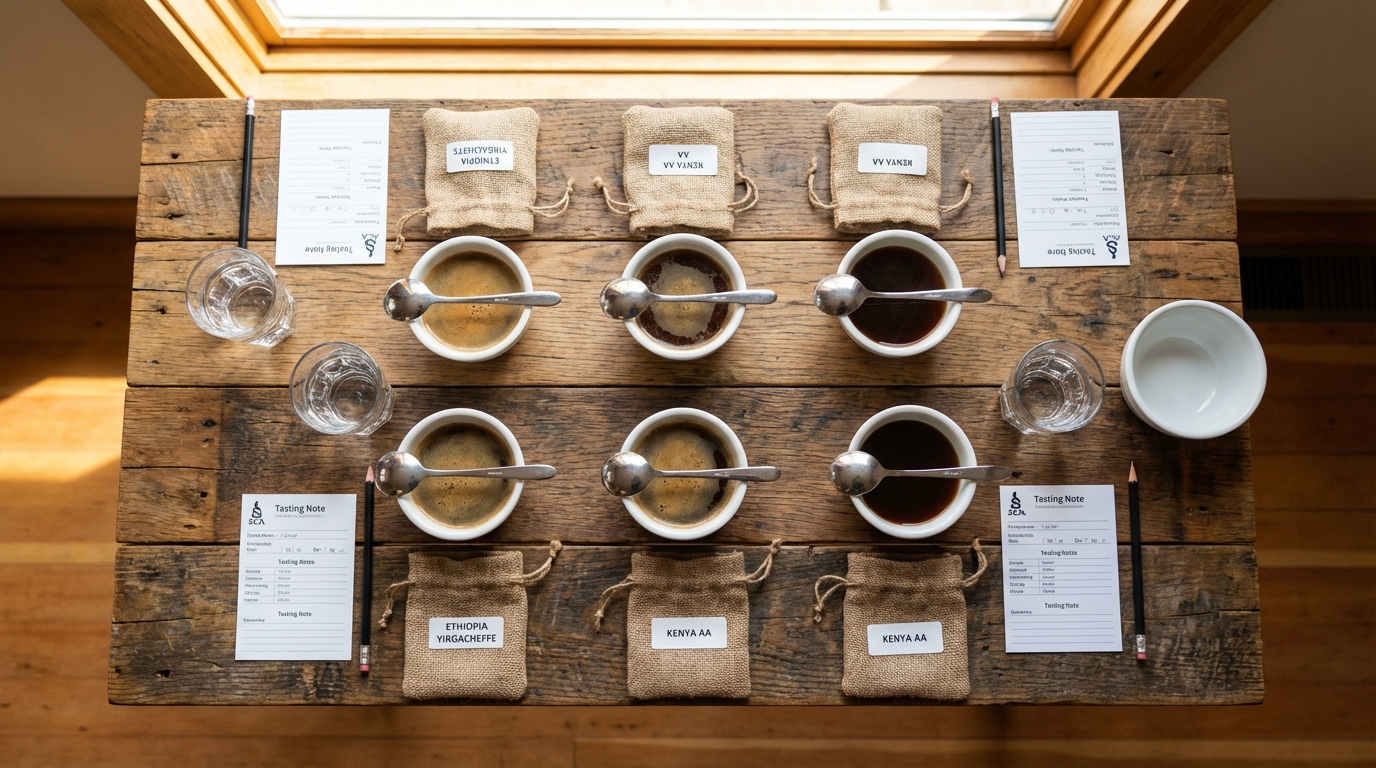
You don't need fancy equipment. Here's what you actually need:
Essential:
- Whole bean coffee (ideally 2–3 different samples to compare)
- Coffee grinder (burr grinder preferred, but blade works)
- Small bowls or cups (200–250ml capacity; ceramic or glass)
- Hot water (just off the boil, ~93–96°C)
- Spoons (soup spoons or proper cupping spoons)
- A timer
- Pen and paper (or a cupping form)
Nice to have:
- Kitchen scale (for precise 8.25g coffee per 150ml water)
- Cupping spoons (wide, deep bowls hold liquid well)
- A second spoon (for skimming)
That's it. You can cup on your kitchen table.
The SCA Cupping Protocol (Simplified)
The official SCA protocol is precise, but here's the home-friendly version:
1. Grind the Coffee
Grind your coffee medium-coarse — think coarse sea salt or French press grind. You want roughly 8–8.5 grams of coffee per 150ml of water. If you don't have a scale, use about one rounded tablespoon per cup.
Grind each coffee separately and immediately before cupping. Freshness matters.
2. Smell the Dry Grounds (Fragrance)
Pour the grounds into your cup and lean in. Take a deep sniff. This is called evaluating the dry fragrance.
What do you notice? Chocolate? Florals? Nuts? Citrus? Don't overthink it — just observe. Your first impression is often the most honest.
3. Add Water and Steep
Pour hot water (just off the boil) directly onto the grounds, filling the cup to the rim. Start your timer. Let it steep for 4 minutes without touching it.
As the coffee steeps, a crust of grounds will form on the surface. Beneath that crust, magic is happening: water is extracting all the soluble flavors from the coffee.
4. Break the Crust (Aroma)
After 4 minutes, it's time to "break the crust." Take your spoon, lean in close, and gently push the floating grounds from the back of the cup toward the front, breaking the surface.
As the crust breaks, a rush of aroma will hit you. Inhale deeply. This is often the most aromatic moment of the entire cupping. Take notes — the aroma will evolve as the coffee cools.
5. Skim the Surface
Use two spoons to skim off the floating grounds and foam from the surface. You want a clean liquid to taste. Don't worry about getting every last particle — just clear the top layer.
6. Taste (The Slurp)
Wait until the coffee cools to around 70°C (roughly 8–10 minutes after pouring). This is where cupping gets noisy.
Dip your spoon into the coffee, scoop up a small amount, and slurp it forcefully into your mouth. The goal is to aerosolize the coffee — spray it across your palate so it hits all your taste receptors at once.
Yes, it's loud. Yes, it feels ridiculous at first. It works.
Let the coffee coat your tongue and palate. Don't swallow immediately — swirl it around, notice the flavors, the texture, the acidity. Then spit (into a separate cup) or swallow.
7. Taste Again as It Cools
As the coffee cools from 70°C to 50°C to room temperature, flavors will shift. Sweetness often emerges more clearly as the coffee cools. Acidity softens. Body becomes more apparent.
Taste at multiple temperatures. A great coffee will remain interesting and balanced all the way down to lukewarm.
What to Look For: The SCA Flavor Wheel
Professional cuppers evaluate coffee on a scorecard with categories like sweetness, acidity, body, balance, aftertaste, and uniformity. For beginners, it's simpler to focus on these dimensions:
Flavor
What does it taste like? Use the SCA Flavor Wheel as a guide. Start broad (fruity? nutty? chocolatey?) and get specific as you practice.
With Guatemalan coffee, you might notice:
- Chocolate (cocoa, dark chocolate, milk chocolate)
- Fruit (apple, stone fruit, berries, citrus)
- Nuts (almond, hazelnut)
- Caramel, brown sugar, honey
Acidity
Not sour — bright. Acidity is what makes coffee lively and complex. Think of the difference between a flat, stale orange and a fresh, zesty one.
Good acidity feels clean and vibrant. Describe it: citric (lemon, lime), malic (apple), or phosphoric (sparkling, effervescent).
Sweetness
How sweet does the coffee taste, without adding sugar? Sweetness balances acidity and bitterness. In high-quality coffee, sweetness is pronounced and pleasant.
Body
How does it feel in your mouth? Light and tea-like? Syrupy? Creamy? Full-bodied?
Guatemalan coffees, especially those from Antigua or Huehuetenango, tend toward medium to full body.
Aftertaste
What lingers after you swallow? A clean, pleasant aftertaste is a hallmark of quality. Bitterness or astringency that won't quit? That's a defect.
Balance
Does everything work together? Or does one element (acidity, bitterness, sweetness) dominate awkwardly?
Cupping Guatemalan Coffee: What to Expect
Since you're reading this on Kapalaj's blog, chances are you're cupping Guatemalan coffee. Here's what to expect from different regions:
Antigua
Classic, balanced, with chocolate and stone fruit notes. Medium to full body. Smooth acidity. This is the crowd-pleaser — approachable but complex.
Huehuetenango
Bright, fruity acidity with floral and citrus notes. Often wine-like. Lighter body than Antigua, but more complexity. High-altitude magic.
Atitlán
Floral and cocoa with a touch of spice. Medium body, silky texture. Volcanic soil influence shows up as minerality.
Cobán
Delicate, tea-like, with tropical fruit and floral notes. Lighter body. Less common but distinctive.
Each region's terroir — altitude, soil, microclimate — creates distinct flavors. Cupping side by side is the best way to learn these differences.
Practice Makes Palate
The first time you cup coffee, you might not pick up on much beyond "tastes like coffee." That's normal. Your palate is like a muscle — it gets stronger with practice.
Here's how to improve:
- Cup regularly. Once a week is better than once a month.
- Cup multiple coffees side by side. Contrast makes differences obvious.
- Use reference flavors. Keep dark chocolate, almonds, dried fruit, citrus nearby. Taste them, then taste the coffee. Train your brain to connect the dots.
- Take notes. Even if they feel vague at first. "Fruity, kinda?" becomes "red apple and apricot" over time.
- Cup with others. Compare notes, discuss, learn from how others describe the same coffee.
Cupping vs. Brewing: Both Matter
Cupping won't replace your morning ritual of a perfectly brewed pour-over or espresso. It's a tool, not a lifestyle.
But once you start cupping, you'll notice things you missed before. You'll recognize quality. You'll understand why one bag costs twice as much as another. You'll stop relying on marketing copy and start trusting your own palate.
And when you taste a truly exceptional coffee — one with clarity, complexity, and balance — you'll know it. Not because someone told you it was good, but because you tasted it yourself.
That's the point.
Want to Try This at Home?
Grab two or three bags of single-origin coffee from different regions. Set up your cupping station. Follow the steps above. Take your time. There's no pressure, no right or wrong answers — just you, the coffee, and whatever you notice.
If you're cupping Kapalaj coffee, we'd love to hear what you find. Share your notes with us on social media or drop us an email. We've cupped these coffees dozens of times ourselves, but your perspective matters too.
The best way to learn coffee is to taste it. So grab a spoon and start slurping.
Looking for more coffee knowledge? Check out our guides on processing methods and why specialty coffee costs more.