
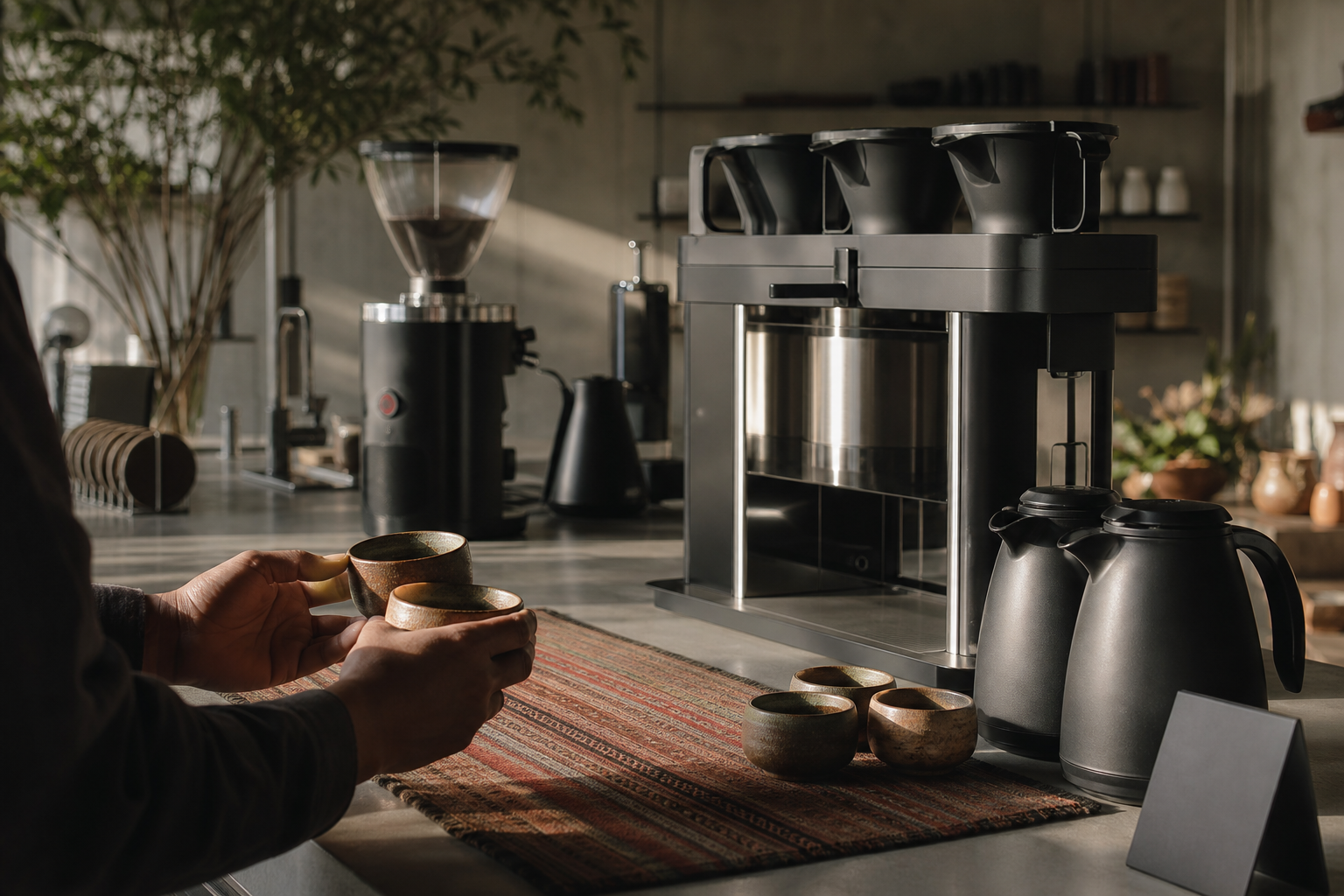
Batch Brew That Still Feels Specialty: How Guatemalan Coffee Works on a Café Bar
July 30, 2026 · 11 min read
Batch brew has an image problem. In too many cafés, it is treated as the practical option: fast, hot, consistent, and slightly less exciting than espresso or a hand-poured filter. But when the coffee is chosen well and brewed with care, batch brew can be one of the clearest ways to show what a single-origin coffee actually tastes like.
That is where Guatemalan coffee deserves more attention. On a busy café bar, the right Guatemalan lot can give guests sweetness, structure, and origin character without asking the team to slow service down for every cup. It can feel generous and polished at the same time: cocoa and caramel depth, clean fruit, enough acidity to stay lively, and enough body to remain comforting.
This article is for café teams, coffee buyers, home brewers who love café-quality filter coffee, and anyone wondering why batch brew should not be an afterthought in specialty coffee.
Quick answer: is Guatemalan coffee good for batch brew?
Yes. Guatemalan coffee is often an excellent choice for batch brew because many lots combine sweetness, balanced acidity, medium body, and a clean finish. Those qualities help the coffee stay expressive in a larger brew, where clarity and consistency matter more than dramatic one-cup theatrics.
For cafés, Guatemalan coffee can work as a bridge between familiar comfort and third-wave origin education. It is approachable enough for guests who normally order a simple black coffee, but distinctive enough to introduce ideas like region, process, altitude, roast level, and traceability.
Why batch brew matters in modern specialty coffee
The specialty-coffee world has spent years celebrating pour-over coffee. That makes sense: brewing one cup at a time can be beautiful, educational, and precise. But in a real café, the filter coffee most guests actually drink may come from a batch brewer.
Batch brew is not less serious by default. It is simply a different service model. A well-dialed batch brew can offer consistency through the morning rush, reduce queue pressure, and give more guests access to thoughtful coffee without turning every order into a slow ritual.
That fits the market. CBI notes that Europe is the world’s largest coffee consumption market, accounting for 30.7% of global coffee consumption in 2023/2024, with value growth expected through premiumisation (CBI European coffee demand). In its specialty coffee analysis, CBI also connects growth with out-of-home consumption, coffee shops, origin stories, taste profiles, and traceability (CBI specialty coffee market potential).
In plain English: people are not only buying caffeine. They are buying a better cup, a clearer story, and a small moment of care. Batch brew can deliver that if the coffee is chosen and served intentionally.
Why Guatemala fits the café batch-brew job
A good batch-brew coffee needs more than a pleasant tasting note on a bag. It has to hold up across time, volume, and different guest expectations. The first cup from the server should taste sweet and lively. The cup poured twenty minutes later should still feel clean, not papery, hollow, or harsh.
Many Guatemalan coffees are useful here because they sit in a balanced sensory space. Compared with a delicate washed Ethiopian coffee, Guatemalan coffee is often less floral and less tea-like. Compared with a classic Kenyan profile, it is usually less sharply blackcurrant-like and less intensely acidic. Compared with many Brazilian coffees, it may feel brighter and more origin-specific. Compared with Colombian coffee, it often shares a familiar chocolate-and-fruit comfort zone, but with its own highland structure and spice.
That makes Guatemala a strong café filter option: expressive, but not polarising.
It also gives staff something real to talk about. Guatemalan Coffees, the origin platform associated with Anacafé, highlights regional profiles such as Antigua Coffee, Highland Huehue, Acatenango Valley, Traditional Atitlán, Rainforest Cobán, Fraijanes Plateau, New Oriente, and Volcanic San Marcos. The platform notes that varietals, microclimates, and growing conditions have a major impact on cup character (Guatemalan Coffees regions and profiles).
For a guest, that does not need to become a lecture. It can be one useful sentence: “This is a Guatemalan batch brew with cocoa sweetness, red-apple brightness, and a clean finish.” That is enough to make the cup feel chosen.
The café problem: batch brew reveals weak decisions
Batch brew is forgiving in workflow, but not in quality. If the roast is dull, the grind is wrong, the water is poor, or the brew sits too long, guests notice. They may not use technical language, but they feel the result: flat, sour, bitter, stale, or forgettable.
Specialty terms help when they clarify the problem:
- Extraction means what water pulls from ground coffee. Too little extraction can taste sour or thin; too much can taste dry or bitter.
- Body means texture or weight in the mouth, from tea-like to round and cocoa-like.
- Acidity in coffee means pleasant brightness, like apple, citrus, or berry. It should not taste like vinegar.
- Traceability means the coffee can be connected to a clearer origin story: a country, region, farm, cooperative, producer group, process, or lot.
The Specialty Coffee Association publishes shared standards and protocols used across the industry for brewing, cupping, and evaluation (SCA coffee standards). A café does not need to turn every batch into a lab exercise, but it does need a repeatable recipe and a habit of tasting before service.
A practical batch-brew recipe for Guatemalan coffee
Use this as a starting point, not a law. Your brewer, grinder, water, roast level, and batch size will all matter.
| Variable | Starting point | What to adjust if it tastes wrong |
|---|---|---|
| Coffee dose | 60 g coffee per 1 litre water | Use 62-65 g/L for more body; 56-58 g/L for a lighter service cup |
| Water temperature | 94-96°C | Go slightly cooler for darker roasts; hotter for light, dense coffees |
| Grind | Medium-coarse filter grind | Finer if sour or weak; coarser if dry, bitter, or slow |
| Brew time | About 4:30-6:00 for many café batches | Short and sour means finer grind; long and bitter means coarser grind or less agitation |
| Holding time | Best within 30-45 minutes | Brew smaller batches more often if the cup fades |
For home brewers, the same ratio works beautifully in a manual brewer: 30 g coffee to 500 g water, or 18 g to 300 g if you want one generous mug. The lesson is the same whether you use a commercial brewer or a kitchen setup: consistency creates clarity.
How to choose the right Guatemalan lot for batch brew
A café batch brew should be easy to recommend. Look for coffees with tasting notes that suggest sweetness and structure, not only acidity.
Good signs include cocoa, brown sugar, caramel, almond, red apple, orange, plum, gentle spice, honey, or milk chocolate. Those notes usually translate well into a larger brew. Very delicate floral notes can be beautiful, but they may become too subtle in batch service unless the roast and recipe are highly controlled.
Washed Guatemalan coffee is often a safe place to start. “Washed” means the fruit is removed before the coffee is dried, which often leads to a cleaner cup. Natural or honey processes can also be delicious, but they may bring more fruit intensity, fermentation character, or texture. That can be exciting for a weekend feature, but it may need more staff explanation.
If you are buying for a café, ask four questions:
- What does this coffee taste like when brewed in volume, not just cupped?
- How does it hold after 20 or 30 minutes in a thermal server?
- Is the roast developed enough for sweetness without tasting roasty?
- Can staff explain the origin in one simple sentence?
That last question matters. A coffee can be excellent and still fail on a busy bar if nobody knows how to present it.
Staff training: the two-cup calibration
Here is a simple training exercise for a café team.
Brew one batch of Guatemalan coffee at your standard recipe. Then brew a second small batch with one deliberate change: grind slightly finer, dose slightly higher, or adjust the water temperature. Taste both side by side as a team.
Ask each person to answer three questions:
- Which cup tastes sweeter?
- Which cup has the cleaner finish?
- Which cup would you confidently serve to a guest who asks for “just a good black coffee”?
This is not about making everyone sound like a competition judge. It is about building a shared service language. If the team can agree that one cup is sweeter, rounder, or cleaner, they can make better decisions during service.
It also keeps specialty coffee accessible. Guests in the US, UK, EU, and Nordic coffee scenes may be familiar with words like “single origin” and “direct trade coffee,” but many still want simple help. They do not need ten tasting notes. They need a reason to choose the cup.
How to describe Guatemalan batch brew to guests
The best café language is short, specific, and useful. Try lines like these:
- “Today’s batch brew is a Guatemalan coffee: cocoa-like sweetness, gentle fruit, and a clean finish.”
- “If you usually like Colombian coffee, this has a similar comfort but a little more highland brightness.”
- “It is lighter and cleaner than a dark roast, but not sharp or thin.”
- “It is a good choice if you want black coffee that still feels sweet.”
Notice what is missing: no pressure, no jargon wall, no superiority complex. Specialty coffee works best when it invites people in.
For more origin context, a café can point curious guests toward Kapalaj’s guide to Guatemala coffee regions or the broader Kapalaj page on Guatemalan origin and craft. For buyers comparing coffees, the Kapalaj shop is the natural next step.
When Guatemalan coffee may not be the right batch brew
No origin solves every menu problem. If your café wants a very heavy, low-acid, roast-forward house coffee, a darker Brazil-led blend may be easier. If your audience is seeking highly floral, tea-like aromatics, a washed Ethiopian coffee might be the clearer feature. If you want piercing acidity and blackcurrant intensity, Kenya may be the better educational contrast.
Guatemala’s strength is balance with character. That sounds modest, but in a café it is powerful. A batch brew that tastes sweet, clean, and memorable can become the cup people reorder without needing to analyze it.
FAQ: Guatemalan coffee for batch brew
Is Guatemalan coffee better as batch brew or pour-over?
It can work well for both. Pour-over gives more control over one cup, while batch brew is better for consistency and speed. A balanced Guatemalan coffee often performs especially well in batch brew because its sweetness and structure remain clear in a larger volume.
What roast level is best for Guatemalan batch brew?
A light-to-medium or medium roast is usually a good starting point. Too light can taste sharp if the recipe is under-extracted; too dark can hide origin character. Look for sweetness, clean acidity, and enough development to feel round.
How much coffee should a café use per litre?
Start around 60 g of coffee per litre of water. Increase the dose slightly if the cup tastes thin, or reduce it if the coffee feels too heavy. Keep grind and brew time consistent when testing.
What tasting notes should I expect from Guatemalan coffee?
Common specialty descriptions include cocoa, caramel, brown sugar, citrus, red apple, stone fruit, spice, and a clean finish. The exact cup depends on region, variety, altitude, process, roast, freshness, and brewing.
Is single-origin coffee practical for busy cafés?
Yes, if the coffee is selected for service and the recipe is stable. Single-origin coffee does not have to mean fragile or slow. A well-chosen Guatemalan coffee can give a café both efficiency and a clear origin story.
Make the everyday cup worth noticing
Batch brew is where specialty coffee proves its hospitality. It is not only for the guest who asks about processing methods or brew ratios. It is for the person who orders quickly, takes one sip, and realizes the coffee is better than expected.
That is a meaningful job for Guatemalan coffee. With the right roast, recipe, and service language, it can turn the most ordinary café order into a small origin experience: warm, sweet, clear, and easy to enjoy.
Explore Kapalaj’s Guatemalan coffees at kapalaj.com and choose beans that make your next filter service feel intentional, whether you brew at home, in a café, or for a team.