
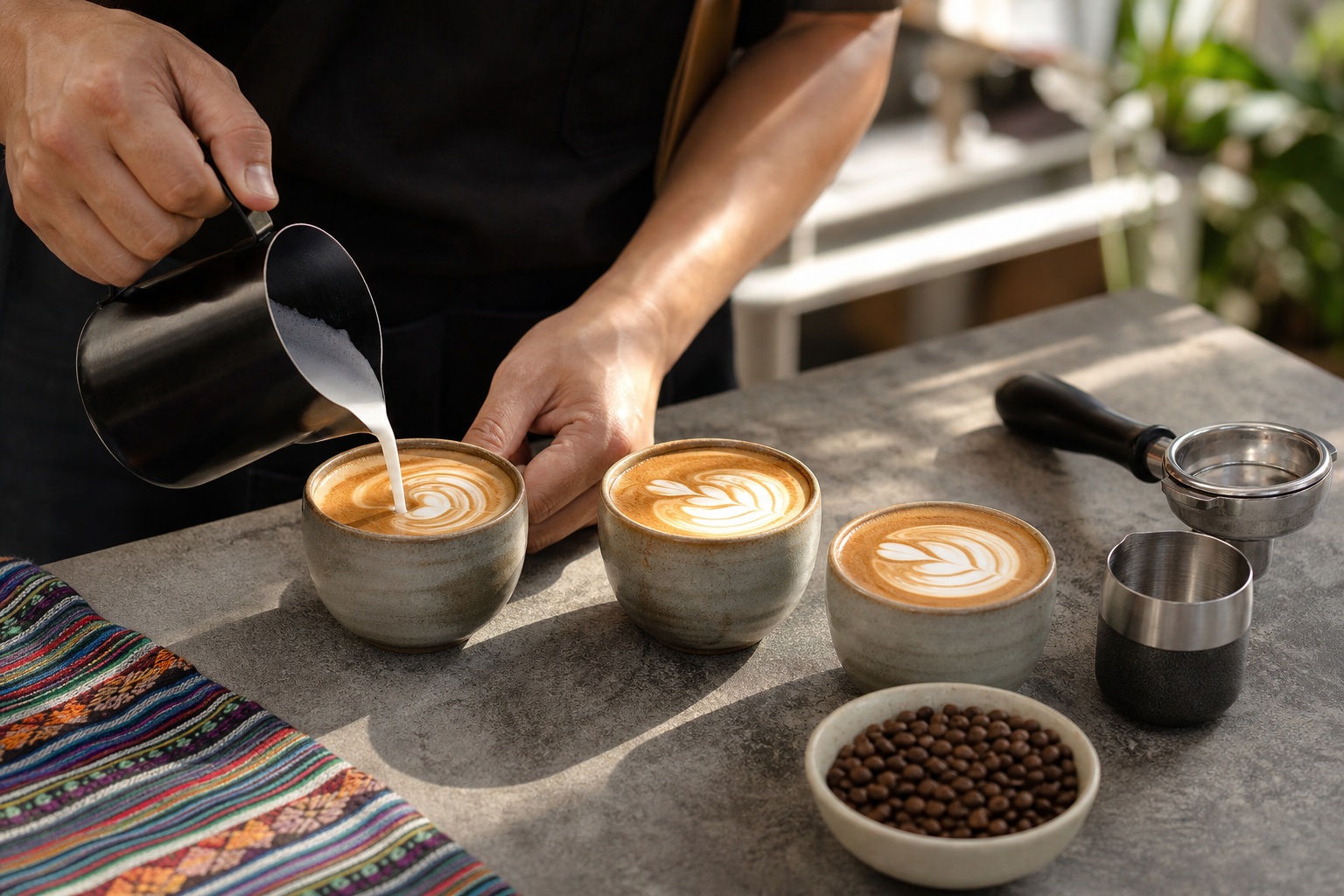
Guatemalan Coffee for Milk Drinks: How to Keep Origin Character in Flat Whites and Cappuccinos
July 21, 2026 · 11 min read
Milk drinks are where many specialty coffee drinkers first fall in love with better coffee. A flat white in a small third-wave café. A cappuccino that tastes like chocolate and orange instead of smoke. A home latte that finally feels sweet without syrup. Then, at some point, the question appears: can single-origin coffee still taste like itself once milk is involved?
It can — but the coffee has to be chosen with intention.
Guatemalan coffee is especially useful for milk drinks because it often sits in a rare middle ground. It has enough body and cocoa-like sweetness to hold its shape in steamed milk, but it can also bring citrus, red apple, stone fruit, spice, and clean highland structure. That means a good Guatemalan espresso can make a flat white feel comforting and origin-led at the same time.
For international specialty coffee drinkers in the US, UK, EU, and Nordic markets, this matters because milk drinks are no longer treated as the opposite of serious coffee. Modern cafés, home espresso setups, and premium office coffee programs all need coffees that can satisfy both the latte drinker and the origin-curious brewer.
Quick answer: is Guatemalan coffee good for milk drinks?
Yes. Guatemalan coffee can be excellent for milk drinks when you choose a roast and profile with enough sweetness, body, and balance. In plain English: look for tasting notes such as cocoa, caramel, toasted nuts, red apple, orange, brown sugar, or gentle spice rather than only delicate florals or very sharp acidity.
A light-medium or medium roasted Guatemalan coffee often works well for flat whites, cappuccinos, and cortados because the espresso can cut through milk without turning bitter. If you want a more classic café profile, choose a rounder Antigua- or Acatenango-style cup. If you want more brightness and fruit, look toward cleaner highland lots such as Huehuetenango, but keep the roast and recipe sweet enough for milk.
Why milk drinks belong in the specialty conversation
Specialty coffee sometimes talks as if black filter coffee is the only serious way to understand origin. That is too narrow. In cafés, offices, hotels, and home kitchens, many people encounter specialty coffee through espresso with milk. The flat white has become a global third-wave staple because it gives drinkers texture, sweetness, and intensity in one small cup.
CBI describes the European market for specialty coffee as growing rapidly, partly through out-of-home consumption, with coffee shops introducing consumers to new varieties, taste profiles, and origin stories (CBI specialty coffee market potential). CBI also notes Europe’s large role in global coffee consumption and the importance of premiumisation — buyers paying more for quality, differentiation, and experience (CBI European coffee demand).
For Kapalaj, a cappuccino can be a gateway into origin education, not a detour away from it. If the coffee is traceable, fresh, well roasted, and brewed carefully, milk can make Guatemalan coffee easier to understand.
What milk changes in coffee flavor
Milk is not neutral. It adds sweetness, texture, and balance.
First, lactose — milk’s natural sugar — becomes more noticeable when milk is steamed properly, amplifying cocoa, caramel, nut, and ripe-fruit notes in Guatemalan coffee.
Second, milk adds texture. Microfoam means very fine bubbles folded into milk, creating a creamy feel rather than a pile of dry foam. This texture can make a coffee feel rounder and more generous.
Third, milk softens acidity and bitterness. Acidity means brightness or liveliness — like orange, apple, or berry — not sourness by default. Bitterness is the harsher edge from over-extraction, very dark roasting, or stale coffee. Milk can soften both, but it cannot rescue espresso that is thin, burnt, or aggressively sour.
This is why Guatemalan coffee works so well in the middle zone. Compared with many Ethiopian coffees, it is often less floral and tea-like. Compared with classic Kenyan profiles, it is usually less sharply blackcurrant-like and high-acid. Compared with Brazil, it often has more lift and origin detail. Compared with Colombia, it may offer a similar comfort zone, but with a distinct Guatemalan mix of cocoa, citrus, spice, and volcanic highland structure.
The best Guatemalan profiles for flat whites and cappuccinos
Guatemala is not one flavor. The origin platform Guatemalan Coffees, associated with Anacafé, presents regions such as Antigua Coffee, Highland Huehue, Acatenango Valley, Traditional Atitlán, Rainforest Cobán, Fraijanes Plateau, New Oriente, and Volcanic San Marcos, connecting cup character to microclimates, varieties, and growing conditions (Guatemalan Coffees regions and profiles). For milk drinks, that regional diversity gives you choices.
Use the table below as a practical starting point rather than a rigid rule.
| If you want... | Look for Guatemalan coffee with... | Why it works with milk |
|---|---|---|
| A classic flat white | Cocoa, caramel, toasted nuts, orange | Milk turns these notes creamy and dessert-like without needing syrup |
| A brighter cappuccino | Red apple, citrus, stone fruit, clean acidity | The fruit stays lively while milk rounds the edge |
| A stronger cortado | Chocolate, spice, structured body | Less milk means the coffee’s intensity can stay clear |
| A sweet home latte | Brown sugar, hazelnut, milk chocolate, soft fruit | Easy to brew, approachable, and forgiving for daily use |
| A more adventurous milk drink | Natural or honey-process fruit, berry, tropical hints | Can taste playful, but needs careful roasting and espresso balance |
Washed Guatemalan coffees are often the safest starting point. “Washed” means the fruit is removed from the coffee seed before drying, usually creating a cleaner and more transparent cup. In milk, washed lots can taste like cocoa, citrus, apple, caramel, and spice with a clear finish.
Natural and honey-processed coffees can also be exciting, but they need care. “Natural” means the coffee dries with the fruit still around the seed; “honey” means some sticky fruit layer remains during drying. These methods can bring more berry, tropical fruit, or fermented sweetness. In milk, that can be beautiful — think strawberry chocolate or fruit caramel — but it can also become heavy if the roast is too developed or the process character is too wild.
Roast level: lighter is not always better for milk
Nordic specialty culture helped popularise lighter roasting: cleaner cups, more acidity, more origin detail, less roast flavour. That has been good for coffee. But milk drinks need a little realism. A very light espresso roast may taste elegant as a pour-over coffee and still feel sharp, thin, or grassy in a cappuccino.
For Guatemalan coffee in milk, the sweet spot is often light-medium to medium. You want enough development for soluble sweetness — the part of the coffee that dissolves into the espresso and tastes like sweetness, body, and structure — without pushing into smoky bitterness.
A helpful rule: if the tasting notes are only floral, lemon, and tea-like, the coffee may be better as filter. If the notes include cocoa, caramel, orange, red apple, brown sugar, nuts, or spice, it has a better chance of working beautifully in milk.
That does not mean darker is always safer. Very dark roasting can flatten the qualities that make single-origin coffee interesting. You may get intensity, but lose Guatemala. The goal is not to make the coffee taste generic. The goal is to let milk frame the origin rather than cover it.
Espresso recipe: start sweet before adding milk
If you brew espresso at home, the most important step is simple: taste the espresso before you add milk. It does not need to be something you would sip slowly on its own, but it should have some sweetness, clarity, and structure.
A good starting recipe for Guatemalan coffee:
- Dose: 18 g coffee in the basket
- Yield: 36–42 g espresso in the cup
- Time: about 26–32 seconds
- Ratio: roughly 1:2 to 1:2.3
- Milk drink size: 130–170 ml for a flat white, 150–180 ml for a cappuccino
If the drink tastes sour and thin, grind finer or pull a little longer. Sour here means sharp in an unpleasant way, like biting into underripe fruit. If it tastes bitter, dry, or hollow, grind coarser, shorten the shot, or check whether the roast is too dark or the coffee too old. If it disappears in milk, use a slightly higher dose, a smaller drink, or a coffee with more chocolate and body.
The Specialty Coffee Association maintains standards and protocols that help coffee professionals speak consistently about brewing, cupping, and quality (SCA coffee standards). You do not need to brew like a competition judge at home, but consistency matters. Change one variable at a time: grind, yield, dose, or milk volume.
No espresso machine? Use a concentrated base
Not every milk drink needs a commercial espresso setup. With an AeroPress, moka pot, or strong French press concentrate, the principle is the same: make a small, intense coffee base that tastes sweet and structured before adding milk. For AeroPress, try 18 g coffee to 90 g hot water, steep 90 seconds, press slowly, then add warm milk. For moka pot, stop the brew before harsh sputtering. Guatemalan coffee with cocoa, caramel, red fruit, orange, or spice will usually feel more satisfying than a very delicate floral coffee once milk is added.
Buying checklist: what to look for on the bag
When shopping for Guatemalan coffee for milk drinks, do not rely on the word “espresso” alone. Some espresso roasts are excellent; others are simply darker. Look for clues that tell you how the coffee will behave.
Choose a bag that gives you:
- Origin clarity: Guatemala plus a region, producer group, farm, or lot when possible.
- Freshness: a roast date, not only a best-before date.
- Roast suitability: light-medium or medium for balanced milk drinks; darker only if you genuinely prefer roast-heavy intensity.
- Milk-friendly notes: cocoa, caramel, chocolate, nuts, orange, red apple, brown sugar, spice, or ripe stone fruit.
- Process information: washed for clarity and balance; honey or natural for more fruit and sweetness.
- Brew guidance: an espresso recipe, filter recipe, or practical note from the roaster.
This is also where traceability matters. In specialty coffee, direct trade coffee and transparent sourcing are not just ethical language; they help explain the cup. If a roaster can tell you where the coffee came from and why it tastes the way it does, you have a better chance of choosing the right beans for your flat white, cappuccino, or home latte.
Kapalaj focuses on traceable Guatemalan specialty coffee, so you can explore the origin story on our Guatemala origin page, compare practical buying options through Kapalaj coffee beans, or read more about espresso choices in our espresso guide.
FAQ: Guatemalan coffee and milk drinks
Is Guatemalan coffee better for espresso or filter?
It can be excellent for both. For filter, Guatemalan coffee often shows clarity, sweetness, and regional nuance. For espresso and milk drinks, choose lots with enough body and sweetness so the coffee stays present after milk is added.
What roast level is best for Guatemalan flat whites?
Light-medium to medium is usually the safest range. It keeps more origin character than a dark roast, but gives the espresso enough sweetness and structure to work with steamed milk.
Does milk hide the taste of single-origin coffee?
Milk changes the taste, but it does not have to hide it. If the coffee has clear sweetness, body, and balanced acidity, milk can make origin notes easier to notice: chocolate becomes creamier, citrus becomes softer, and spice becomes warmer.
Is Guatemalan coffee less acidic than Ethiopian or Kenyan coffee?
Often, yes, though every lot is different. Many Guatemalan coffees feel balanced and structured, with citrus or apple-like brightness rather than the intense florals of some Ethiopian coffees or the sharp blackcurrant-like acidity of some Kenyan coffees.
The takeaway: milk drinks can still tell an origin story
A flat white does not have to be a compromise. A cappuccino does not have to taste like anonymous roast and foam. With the right beans, milk can become a frame for origin: softening acidity, amplifying sweetness, and giving Guatemalan coffee a generous texture that makes people want another sip.
The practical takeaway is simple: choose Guatemalan coffee with cocoa sweetness, rounded body, and enough fruit to stay alive in milk; brew the espresso sweet before you steam; and keep the drink small enough that the coffee still leads.
If you want milk drinks that feel creamy, balanced, and genuinely connected to origin, explore Kapalaj’s Guatemalan coffees and choose beans that can carry your next flat white, cappuccino, or home latte with clarity.