A good bag of Guatemalan coffee can feel generous: cocoa sweetness, orange-like brightness, toasted almond, soft spice, sometimes ripe red fruit or a clean floral lift. Then, two weeks later, the same coffee can taste oddly quiet. Not bad exactly. Just flatter, drier, less alive.
For many specialty coffee drinkers, storage is the invisible brew variable. We talk about grind size, water temperature, espresso yield, and pour-over technique, but the coffee may have lost part of its voice before it reaches the grinder. If you buy single-origin coffee because you care about origin character, freshness is part of what you paid for.
This guide explains how to store Guatemalan coffee at home without turning your kitchen into a laboratory: oxygen, light, heat, moisture, freezing, grinding, and buying habits.
Quick answer: how should you store Guatemalan coffee?
Store Guatemalan coffee as whole beans in an airtight, opaque container, away from heat, sunlight, steam, and strong kitchen smells. Grind only what you need just before brewing. If you buy more than you can drink within a few weeks, freeze unopened or well-sealed portions and thaw only the portion you plan to use.
The goal is simple: protect the aromatics that make specialty coffee taste like more than “strong” or “mild.” With Guatemalan coffee, good storage helps preserve the cup’s cocoa sweetness, citrus clarity, and rounded body.
Why storage matters more as coffee gets better
Specialty coffee culture in the US, UK, EU, and Nordic countries has trained drinkers to expect origin, variety, process, roast, brew method, and producer story. CBI notes that European specialty coffee demand is supported by cafés introducing consumers to new varieties, flavour profiles, and origin stories (CBI specialty coffee market potential). People are not only buying caffeine. They are buying traceable flavour.
CBI also describes Europe as the world’s largest green coffee market and reports that Europe accounted for 30.7% of global coffee consumption in 2023/2024 (CBI coffee demand report). Premium coffee is no longer a tiny niche. More home brewers are paying for carefully sourced beans and trying to recreate café-quality cups at home.
Storage is where that ambition often succeeds or fails. Colombian coffee may lose caramel and apple clarity. Ethiopian coffee may lose perfume. Kenyan coffee may turn sharper. Guatemalan coffee, often prized for balance, can become dull if its aromatics fade.
What freshness actually means
Freshness is not just “recently roasted.” It is the condition of the coffee when you brew it.
After roasting, coffee releases carbon dioxide. This is called degassing. Too much gas can make very fresh coffee brew unevenly, especially in espresso. But over time, oxygen, heat, light, and moisture also change the aromatic compounds and oils that create flavour. In plain English: coffee slowly loses the smell and sweetness that make it exciting.
The National Coffee Association’s storage guidance recommends keeping coffee in an airtight container in a cool, dark place and protecting it from air, moisture, heat, and light (NCA coffee storage guide). That advice sounds basic, but it solves most home storage problems.
For Guatemalan coffee, freshness is easiest to understand through what disappears:
Swipe the table sideways to see all columns.
| If freshness fades | What you may notice in the cup |
|---|---|
| Aromatics decline | Less fragrance when grinding, fewer fruit or floral notes |
| Sweetness drops | Cocoa and brown sugar notes feel thinner |
| Acidity loses clarity | Citrus becomes dull, sharp, or papery |
| Body feels rougher | The cup tastes dry rather than rounded |
| Finish shortens | Flavour vanishes quickly after swallowing |
Fresh coffee does not guarantee a perfect brew, but stale coffee makes precision less rewarding.
Why Guatemalan coffee is a useful freshness test
Guatemala is not one flavour profile. Guatemalan Coffees, the origin platform from Anacafé, describes regions including Antigua, Acatenango Valley, Atitlán, Cobán, Fraijanes Plateau, Highland Huehue, New Oriente, and Volcanic San Marcos, and highlights how microclimate and growing conditions shape regional profiles (Guatemalan Coffees regional profiles).
That diversity is part of the appeal. Antigua can bring elegant cocoa, spice, and citrus. Huehuetenango is often loved for lively acidity and fruit depth. Atitlán may feel layered and aromatic. Acatenango can show structure, sweetness, and clean brightness.
Yet many Guatemalan specialty coffees share a helpful middle ground: they are expressive without being fragile, sweet without being heavy, and bright without demanding that every drinker loves high-acid coffee. Compared with a classic Brazilian coffee, Guatemala often gives more citrus lift and origin definition. Compared with many Ethiopian coffees, it may be less floral but more chocolate-toned and grounded. Compared with Kenya, it is usually less intensely blackcurrant-like and more rounded.
That balance makes storage problems easier to spot. If a Guatemalan coffee that should taste like cocoa, orange, and soft spice becomes papery and flat, the issue may not be the farm, roast, or brew method. It may be how the beans lived on your shelf. For more background on why Guatemala’s regions taste different, see Kapalaj’s guide to origin and sourcing.
The practical storage checklist
Here is the simplest way to protect a good single-origin coffee at home.
1. Keep it whole bean
Whole beans age more slowly than ground coffee because less surface area is exposed to oxygen. Grinding is like opening thousands of tiny doors at once. Aroma escapes quickly, and oxygen gets in.
If you want the clearest expression of Guatemalan coffee, buy whole beans and grind just before brewing. This matters for pour-over, French press, AeroPress, batch brew, and espresso. Pre-ground coffee can still be convenient, but it will lose definition faster.
2. Use an airtight container
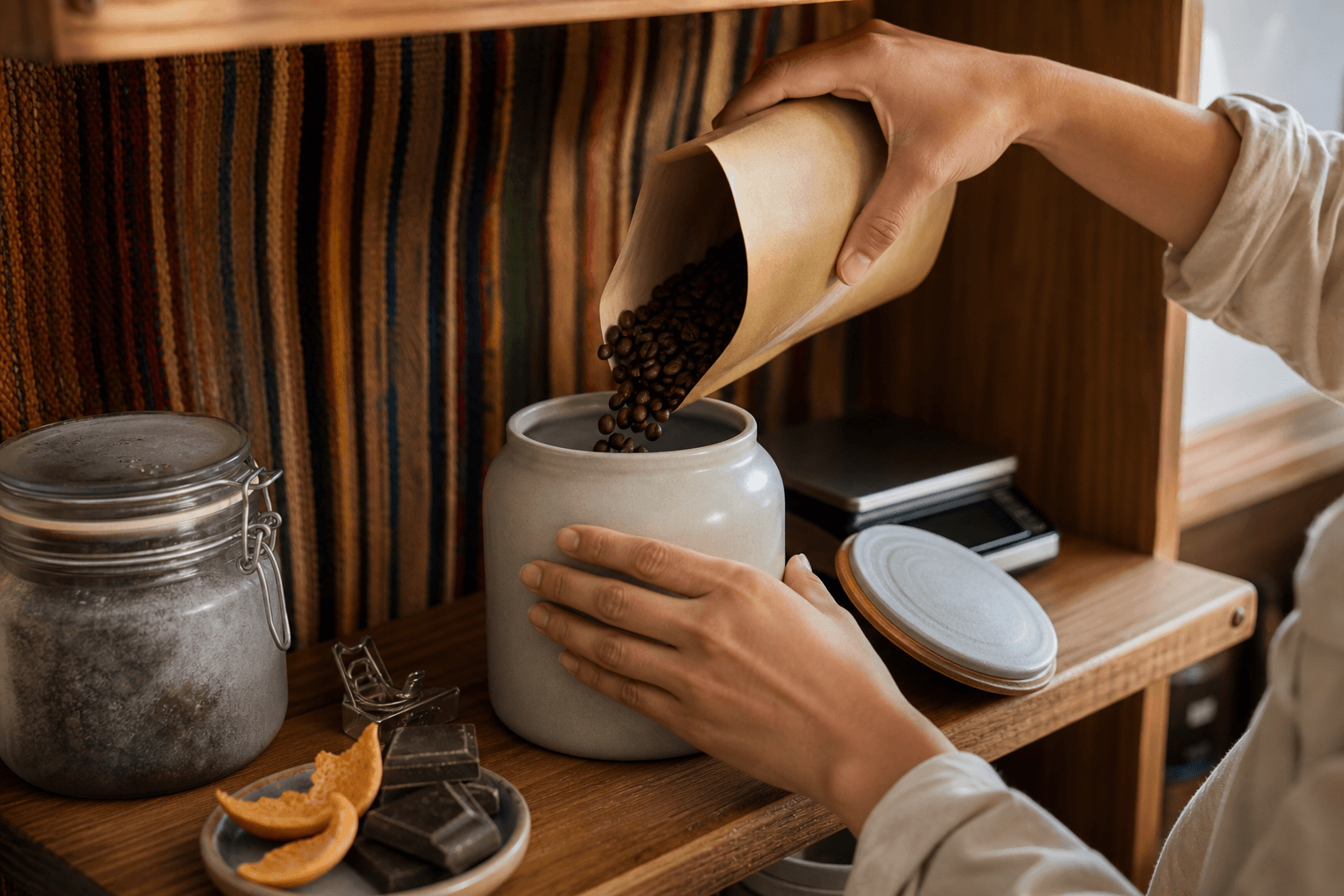
A resealable coffee bag is often acceptable if it closes well and you squeeze out extra air. A dedicated airtight canister is better, especially if the bag is flimsy or used daily. Opaque containers are ideal because they protect against light as well as air.
Avoid clear jars on sunny shelves. They may look beautiful, but sunlight and warmth are not kind to coffee.
3. Store coffee away from heat and steam
The worst common storage spot is next to the stove, above the kettle, or near a sunny window. Steam adds moisture. Heat speeds up ageing. Light damages aroma.
A cupboard or pantry shelf is usually better than a countertop. Think cool, dark, dry, and calm.
4. Keep coffee away from strong smells
Coffee absorbs odours easily. That is why storing beans beside spices, onions, cleaning products, or an open fridge can be risky. You do not want your Guatemalan coffee to carry a faint note of garlic, curry powder, or refrigerator air.
This is especially important for lighter roasted specialty coffee, where delicate aromatics are part of the experience.
5. Buy in portions you can actually drink
The most elegant storage solution is buying the right amount. If you drink one cup a day, a large bag may not be a bargain if the last third tastes tired. Smaller, fresher purchases often deliver better value in the cup.
For Kapalaj-style buying, think about your real brewing rhythm. Are you making one morning pour-over? A weekend espresso ritual? A daily office batch brew? Match the bag size to the pace.
Should you freeze Guatemalan coffee?
Yes, freezing can be useful if you do it carefully. Freezing is not a magic upgrade, but it can slow ageing when you have more coffee than you can brew while fresh.
The key is moisture control. Coffee should go into the freezer in airtight, portioned packaging. Do not place an open daily-use bag in the freezer, remove it every morning, let condensation form, and put it back. That routine invites moisture, which is one of coffee’s enemies.
A better approach:
- Divide whole beans into portions you will use within a week or two.
- Seal each portion tightly in a freezer-safe bag or jar with as little air as possible.
- Freeze the portions you will not use soon.
- When needed, remove one portion and let it come to room temperature before opening.
- Keep that thawed portion in a cupboard and use it normally.
Freezing is especially helpful for rare, seasonal, or direct trade coffee that you want to enjoy over time. It is less necessary if you buy small bags and drink them quickly.
When is coffee too fresh?
Freshness has a sweet spot. Coffee brewed immediately after roasting can be gassy and unsettled. In espresso, very fresh beans may produce excessive crema, unstable flow, and sharp flavours. In pour-over, the bloom may foam dramatically while the cup tastes slightly uneven.
Many specialty coffees become more balanced after a short rest. The exact timing depends on roast level, process, density, and brew method, but a useful home rule is this:
Swipe the table sideways to see all columns.
| Brew method | Practical freshness window |
|---|---|
| Pour-over coffee | Often opens nicely after a few days of rest |
| Espresso | Often benefits from a longer rest than filter coffee |
| French press | Forgiving, but aromatics still decline with age |
| Cold brew | Can use slightly older beans, but stale coffee still tastes flat |
These are not rigid rules. They are starting points. The best guide is your cup.
Storage and roast level
Roast level changes how coffee ages. Darker roasts are more porous and can show surface oils sooner, so they often lose freshness faster. Light-to-medium Guatemalan coffees may keep structure longer, but they still lose aroma if stored badly. Freshness and roast should work together: good storage keeps the origin visible.
A simple freshness tasting test
If you are unsure whether storage is affecting your coffee, try this small comparison.
Brew the same Guatemalan coffee two ways:
- one cup from beans stored in the original bag, opened daily for several weeks
- one cup from beans stored airtight, away from heat and light, or from a frozen portion thawed properly
Use the same recipe, grinder, water, and brew method. Then taste for four things:
- Aroma: Does one smell more vivid when ground?
- Sweetness: Is the cocoa or caramel note clearer?
- Acidity: Does citrus taste clean or dull?
- Finish: Does the flavour linger pleasantly?
This is the kind of practical sensory learning that specialty coffee is built on. SCA standards and protocols exist partly to create shared language for evaluating coffee quality and brewing variables (SCA coffee standards). At home, you do not need formal cupping bowls to borrow the mindset: change one variable, taste carefully, and learn.
Buying guidance: choose coffee you can protect
Storage starts before the bag reaches your shelf. When buying Guatemalan coffee online or in a specialty shop, look for:
- a roast date or clear freshness information
- whole bean options
- packaging that closes well
- origin information beyond “Guatemala” when available
- a roast profile suited to your brew method
- a quantity that matches your drinking pace
Traceability matters here too. When a coffee names a region, farm, cooperative, process, or producer relationship, it invites you to treat the bag as something specific. Direct trade coffee and transparent sourcing are flavour ideas as well as ethical ones: if a distinctive lot has been protected from farm to roaster, good home storage helps keep it expressive until the last brew.
FAQ: storing Guatemalan coffee
Should Guatemalan coffee be kept in the fridge?
Usually, no. A refrigerator is humid and full of food smells. Coffee can absorb odours, and repeated temperature changes can create condensation. A cool, dark cupboard is better for daily use.
Is it better to store coffee in the original bag or a canister?
If the original bag is high quality and reseals well, it can work. An airtight, opaque canister is often better for daily use, especially if the bag does not close tightly. The main goal is to reduce air, light, heat, moisture, and odours.
Can I freeze single-origin Guatemalan coffee?
Yes. Freeze whole beans in airtight, portioned packs, then thaw one portion at a time before opening. Do not repeatedly move the same open bag in and out of the freezer.
How long does Guatemalan coffee stay fresh?
It depends on roast date, packaging, roast level, and storage. For the best specialty coffee experience, buy amounts you can drink within a few weeks, keep beans whole, and protect them from air, light, heat, and moisture.
Does old coffee need a different brew recipe?
Sometimes a finer grind or hotter water can help, but technique cannot restore lost aroma. If the cup tastes papery, flat, or hollow, freshness may be the limiting factor.
The takeaway: freshness is part of origin quality
Guatemalan coffee can be forgiving, but it is not indestructible. Store it well and you keep more of what makes it worth buying: cocoa sweetness, citrus clarity, rounded body, and the quiet complexity of Guatemala’s coffee regions.
The best rule is easy to remember: buy whole beans in realistic amounts, keep them airtight, cool, dark, dry, and away from odours, and freeze only in sealed portions.
If you want to taste Guatemalan coffee at its clearest, explore Kapalaj coffees and choose a bag you can brew fresh, store well, and enjoy.