
Why Guatemalan Coffee Still Wins Specialty Coffee Drinkers Over
April 14, 2026 · 9 min read
Guatemalan coffee has a rare kind of staying power in specialty coffee. It does not need to shout. It does not rely on novelty. It just keeps showing up in cupping rooms, café menus, and home brewers’ regular rotation because it does something incredibly hard: it tastes balanced and distinctive at the same time.
That balance matters. In the US, UK, and across Europe, specialty coffee drinkers have become more educated than ever. They know the difference between washed and natural processing, they can tell a V60 from an espresso roast, and many of them can pick out an Ethiopian coffee in the first sip. But when they want a single-origin coffee that feels immediately trustworthy, Guatemalan coffee is often near the top of the list.
Why? Because Guatemala sits in a sweet spot. The country’s high-altitude coffee regions, volcanic soils, careful harvesting, and long history of coffee production create cups that are usually sweet, structured, and clean, with enough fruit or citrus to stay interesting. It is the kind of coffee that can satisfy a seasoned barista, a home brewer chasing a better pour-over coffee, and a curious buyer just stepping into specialty coffee for the first time.
What Guatemalan coffee usually tastes like
If you taste a lot of Guatemalan coffee, a pattern starts to emerge. Not every lot is the same, of course, but many coffees from Guatemala share a family resemblance:
- cocoa or dark chocolate
- caramel, brown sugar, or molasses sweetness
- hazelnut, almond, or other soft nutty notes
- orange, apple, or stone fruit brightness
- a clean finish with good structure
- a body that feels present without being heavy
That mix is part of the appeal. Ethiopian coffees often lean more floral, tea-like, and wild. Colombian coffees tend to be polished, sweet, and versatile. Kenyan coffees can be electric, high-acid, and intensely structured. Guatemalan coffee usually lives somewhere in the middle of that conversation, which is exactly why so many people keep returning to it.
It gives you clarity without fragility. Sweetness without simplicity. And enough origin character to make the cup feel specific rather than generic.
Why Guatemala matters in specialty coffee
Coffee from Guatemala matters because it is one of the clearest examples of how place shapes flavour. The country’s coffee regions sit at high elevations, often between volcanic mountain ranges and fertile valleys. Cooler nights slow cherry development, which usually gives the coffee more density and more time to build sugars.
In plain English: the beans often grow slowly, and slow growth tends to produce more interesting flavour.
That is one reason Guatemalan coffee has such a strong reputation in third-wave coffee culture. Roasters in the US, UK, and EU value coffees that are readable, reliable, and expressive. Guatemala often delivers all three. You can roast it in a way that highlights fruit and acidity, or in a slightly more developed style that brings out chocolate and caramel. It plays well in a lot of settings.
It is also a useful origin for anyone learning about single-origin coffee. A good Guatemalan lot teaches you how a coffee can be sweet and nuanced without being loud. That is a valuable lesson, especially for home brewers who are still figuring out what they actually like.
The coffee regions of Guatemala are a big part of the story
One of the best things about Guatemalan coffee is that it is not one-dimensional. The coffee regions of Guatemala each bring a slightly different expression, and that makes the origin worth exploring in depth.
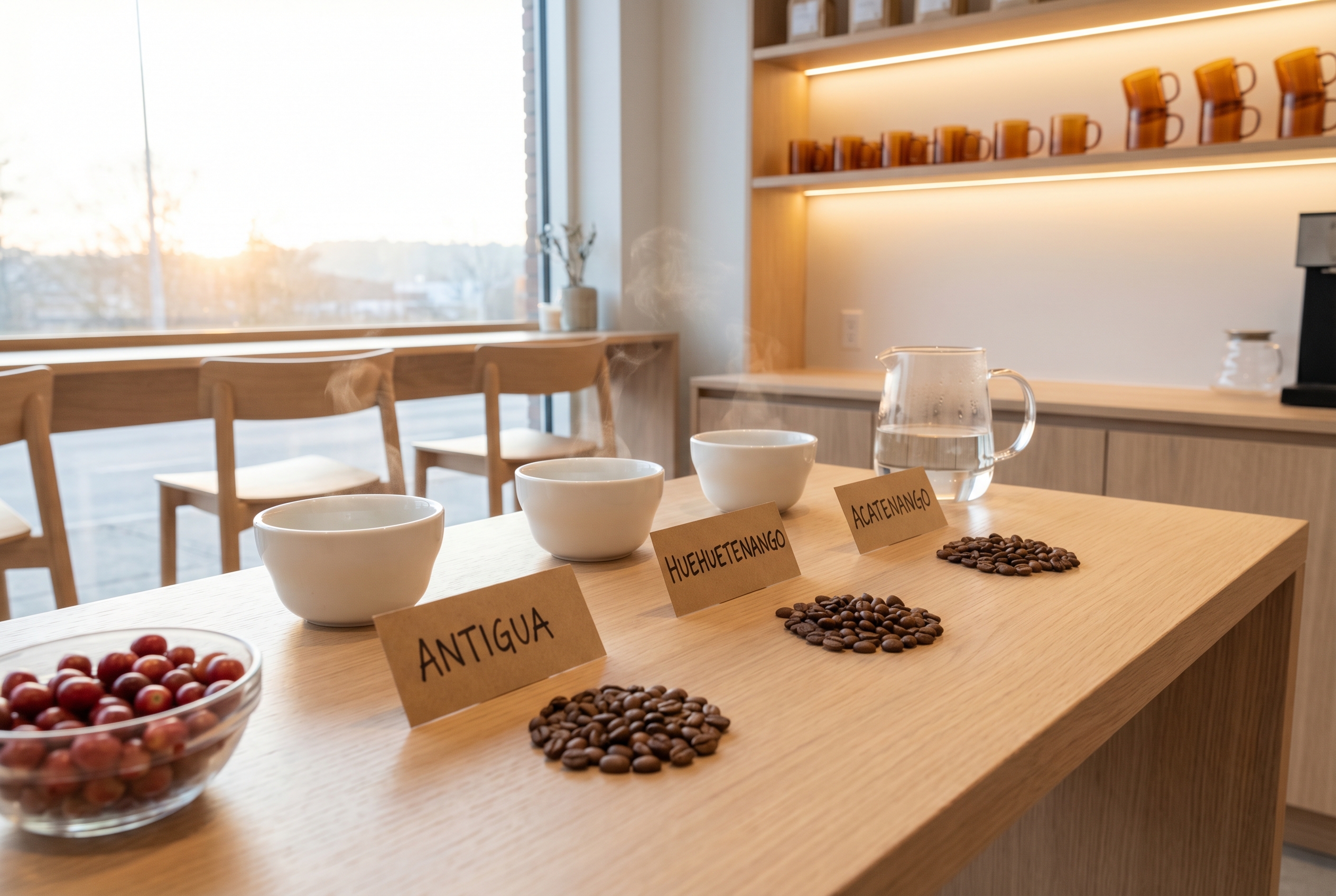
Antigua
Antigua is probably the most familiar name for many specialty coffee drinkers. Coffees from this region are often round, balanced, and chocolate-forward, with gentle citrus and a polished finish. If you want a coffee that feels classic but still clearly specialty, Antigua is a very safe and very smart place to start.
Huehuetenango
Huehuetenango often brings more lift. Expect livelier acidity, more fruit, and a more dynamic cup. It is a region that can feel especially exciting in pour-over coffee because the clarity helps the sweetness and fruit open up.
Acatenango
Acatenango coffees often feel clean and structured, with a nice mix of sweetness and brightness. They can be a bit more elegant than dense, which makes them especially good for brewers who like tidy, transparent cups.
Atitlán
Around Lake Atitlán, coffee can show a more expressive, sometimes floral or citrus-led profile. It is another reminder that Guatemala is not just a “chocolate and nut” origin. It can also be vivid and refined.
If Ethiopia is the origin that teaches many people about perfume-like aromatics, and Kenya is the origin that teaches people about sharp, sparkling acidity, Guatemala is often the origin that teaches balance with depth.
The role of direct trade coffee
For many modern coffee buyers, the story behind the coffee matters almost as much as the flavour. That is where direct trade coffee comes in.
Direct trade usually means closer relationships between producers and buyers, with more transparency around quality, pricing, and farm-level decisions. It is not a magic label, and it does not solve every problem in coffee. But when done well, it can support better communication and better incentives.
For Guatemala, that matters a lot. Many farms are relatively small, and the best coffees often come from producers who are making careful decisions at every step, from picking ripe cherries to drying the parchment at the right pace. When buyers pay attention to those decisions and reward quality fairly, the result is usually better coffee for everyone.
For drinkers, the practical benefit is simple: more traceability, more consistency, and a better chance that what you taste in the cup reflects actual craft rather than marketing.
How to brew Guatemalan coffee at home
If you want to get the most out of Guatemalan coffee, start with methods that show clarity.
Pour-over coffee is the best first move
Pour-over coffee is ideal because it highlights sweetness, structure, and origin character without overwhelming them. A V60, Kalita, or similar brewer will usually make it easy to taste what is special about the coffee.
Try this as a starting point:
- ratio: 1:16
- water temperature: 92 to 94°C
- grind: medium
- brew time: around 2:30 to 3:30, depending on your dripper
What to taste for:
- a cocoa or caramel base
- a clean, sweet middle
- citrus, apple, or stone fruit brightness
- a finish that fades cleanly instead of turning harsh
If the cup feels weak or thin, grind a little finer. If it turns sharp or drying, go slightly coarser and reduce agitation.
Espresso works too
Guatemalan coffee can be excellent as espresso, especially if the roast preserves enough sweetness and body. In espresso, the chocolate and caramel notes often become more obvious, while the acidity settles into the background.
That makes it particularly friendly for milk drinks. A good Guatemalan espresso can hold its own in a cappuccino or flat white without disappearing.
A concrete reader takeaway
If you only do one thing, brew the same Guatemalan coffee two ways, as pour-over and as espresso, and compare the results. That comparison will teach you more about the coffee than reading a dozen tasting notes.
How Guatemalan coffee compares to Ethiopia, Colombia, and Kenya
This is where origin context becomes genuinely useful.
Compared with Ethiopian coffee, Guatemalan coffee usually feels less floral and more grounded. Ethiopian coffees can be dazzling, but they sometimes trade approachability for intensity. Guatemala is often the easier everyday coffee, while still being complex enough to reward attention.
Compared with Colombian coffee, Guatemala can feel slightly deeper and firmer. Colombia is often silky and balanced, while Guatemala tends to bring a more defined cocoa core and a little more mineral structure.
Compared with Kenyan coffee, Guatemala is gentler and less explosive. Kenya can be thrilling, but it is not always the coffee you want in a big mug on a Tuesday morning. Guatemala is often more versatile and more forgiving.
That versatility is a big reason it has such an important place in international specialty coffee. It can sit comfortably on a cupping table next to flashy origins and still feel complete.
What to look for when buying Guatemalan coffee
Not every bag from Guatemala is equally exciting. The best ones usually have a few things in common:
Clear origin information
Look for region, farm, or cooperative details if possible.A roast that respects sweetness
Too dark, and the origin character gets buried.Freshness
Good Guatemalan coffee should taste alive, not stale or flat.A flavour profile that suits your brew method
Cleaner lots often shine in filter; fuller lots can be great for espresso.
If you are buying for home brewing, a medium-light or medium roast is often the sweet spot. It preserves enough clarity for pour-over coffee while keeping the chocolate and caramel notes that make Guatemalan coffee so easy to like.
Food pairings that actually work
Guatemalan coffee is one of the easiest origins to pair with food. Its cocoa, nut, and citrus notes make it flexible.
Good pairings include:
- almond croissants
- dark chocolate
- cinnamon buns
- buttered toast with jam
- orange cake
- simple pastries that are sweet but not too rich
If you are serving guests, this is a smart origin to choose because it appeals to both specialty coffee regulars and people who simply want a really good cup of coffee with breakfast.
Why it still wins people over
Guatemalan coffee keeps winning people over because it solves a real problem in specialty coffee: how do you make something interesting without making it difficult?
Some origins are fascinating but demanding. Others are comforting but forgettable. Guatemala often sits in the perfect middle. It gives you a cup that is easy to understand on day one, but still has enough detail to stay rewarding as your palate develops.
That is why it keeps showing up in cafés from Brooklyn to Berlin, London to Copenhagen. And that is why it belongs in a serious home brewer’s rotation too.
Final takeaway
If you want one origin that can teach you about balance, sweetness, and regional nuance in specialty coffee, Guatemalan coffee is a very strong choice. Start with a clean pour-over, taste for cocoa and citrus, and pay attention to how different coffee regions of Guatemala shift the cup.
Explore Guatemalan coffee with Kapalaj
If this made you want to taste the origin properly, explore Kapalaj’s Guatemalan coffees and find the single-origin coffee that fits your brew style best.