When people talk about Guatemalan coffee, the usual names show up fast: Antigua, Huehuetenango, Atitlán. They deserve the attention. But if you spend enough time in specialty coffee, you eventually start looking for the quieter names — the regions that don’t always dominate the shelf, but often deliver the most interesting cups.
Acatenango is one of those places.
For coffee drinkers in the US, UK, or across Europe, Acatenango may still sound more like a volcano than a coffee origin. That’s part of the charm. It sits in the shadow of some of Guatemala’s most dramatic landscapes, and the coffee reflects that same sense of tension and structure: bright, clean, sweet, and shaped by altitude in a way that makes you pay attention.
If you like specialty coffee for the same reason people like good natural wine or single-vineyard wine, Acatenango is the kind of origin that rewards curiosity.
Where Acatenango sits in Guatemala’s coffee map
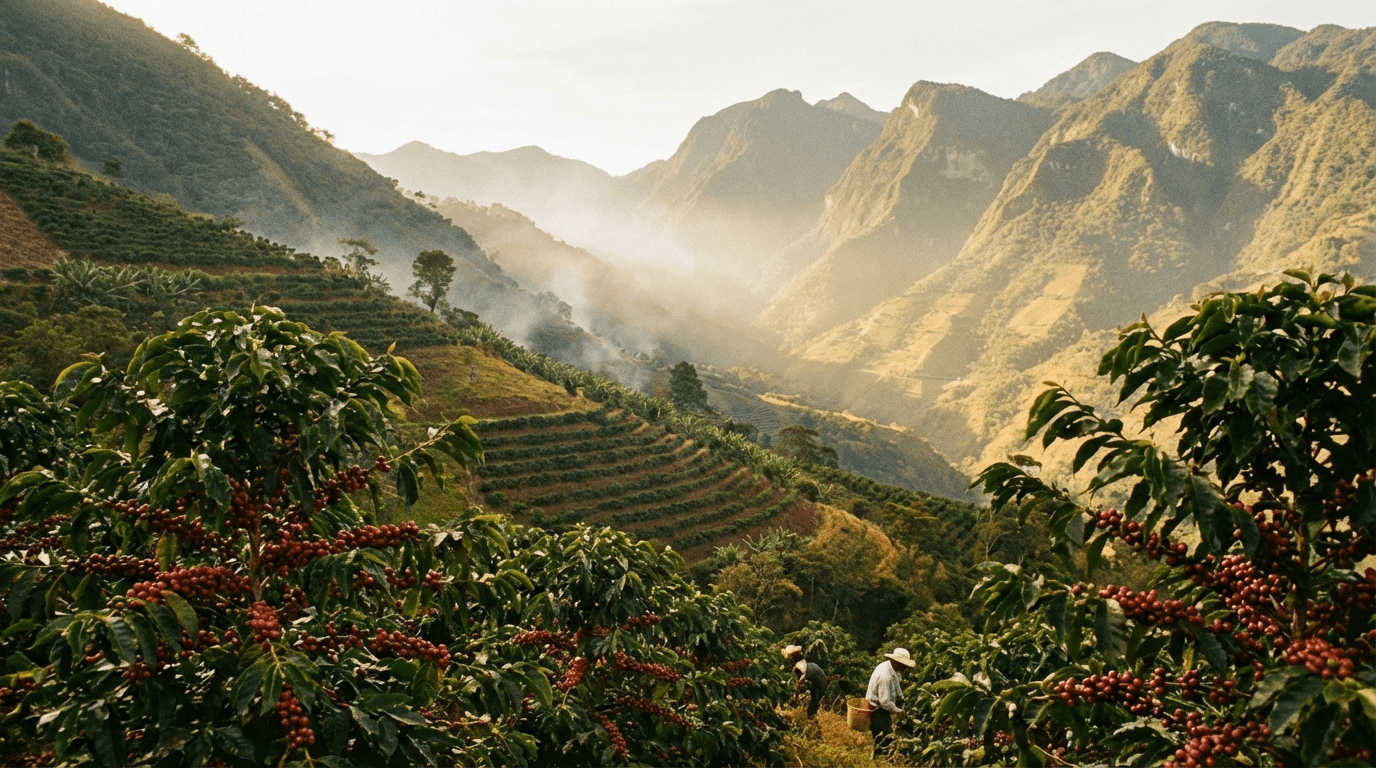
Acatenango is located in Guatemala’s central highlands, close to Antigua and framed by the volcanic landscape that makes the country such a powerful coffee origin. The name comes from the Acatenango volcano, part of a trio of giants that includes Fuego and Agua in the broader volcanic belt.
That matters because Guatemalan coffee is never just about “country of origin.” It’s about microclimate, elevation, soil, shade, rainfall, and how all of those things come together on a specific slope. In a country as compact as Guatemala, those differences are huge.
Acatenango often grows at high elevations, where cool nights slow cherry development and let flavour compounds build more gradually. That slower maturation tends to create denser beans and a cleaner, more articulate cup — the kind of cup that specialty buyers love because it speaks clearly rather than shouting.
What Acatenango tastes like
There isn’t a single flavour profile for every coffee from Acatenango, because processing and farm practice still matter enormously. But in general, you can expect a cup that sits in the classic Guatemalan sweet spot:
- medium to full body
- bright but controlled acidity
- cocoa and caramel sweetness
- stone fruit or citrus top notes
- a clean finish with very little roughness
Think of it as a coffee that has structure without being heavy.
If Antigua is the polished classic and Huehuetenango is the high-wire act, Acatenango often lands somewhere in between. It can feel a little more vivid than Antigua, a little more grounded than the most fruit-forward highland lots, and very comfortable in the kind of balanced profile many specialty coffee drinkers want every day.
For someone coming from mainstream coffee, it still feels approachable. For someone already deep into single-origin coffee, it has enough nuance to stay interesting cup after cup.
Why specialty coffee buyers care about origins like this
In third-wave coffee culture, origin is not just a label. It’s a clue.
A bag that says Guatemalan coffee tells you the coffee likely comes from high-altitude Arabica grown in volcanic soils, but a bag that says Acatenango tells you even more. It gives you a narrower lens on flavour, farming conditions, and potential cup character.
That’s the appeal of single-origin coffee in the first place. You’re not trying to hide the coffee inside a blend. You’re trying to taste the place.
Specialty coffee has trained a lot of drinkers to expect that kind of transparency. In London, Oslo, Berlin, Amsterdam, New York, Melbourne — wherever the coffee scene has matured — people want to know where their coffee came from and why it tastes the way it does. Origins like Acatenango answer those questions beautifully because the geography is so legible in the cup.
Acatenango vs. Antigua: close neighbours, different personalities
Acatenango and Antigua are geographically close, and both sit inside Guatemala’s volcanic highlands. But they do not taste identical.
Antigua is the region most people associate with the “classic” Guatemalan profile: chocolate, caramel, restrained citrus, plush body. It’s elegant and deeply reliable.
Acatenango often feels a touch more lifted. Depending on the lot, you may notice:
- slightly brighter fruit
- a firmer, more energetic acidity
- a cleaner, more linear structure
- a more pronounced sweetness when brewed well
That doesn’t make it better than Antigua. It makes it different. And in specialty coffee, difference is the whole game.
A great comparison is the way coffee drinkers talk about Colombian regions. Huila doesn’t taste like Nariño, and neither tastes like Tolima, even though they all sit under the broad umbrella of Colombia. Guatemalan coffee works the same way. The national identity is there, but the regional expression is what gets exciting.
Acatenango in the context of other famous origins
If you’re used to Ethiopian coffee, Acatenango will probably feel more grounded and chocolate-driven. Ethiopian coffees can be wonderfully floral, tea-like, and sparkling, sometimes almost winey in the cup. Acatenango is usually less flamboyant. It doesn’t chase the same level of aromatic drama.
If you’re used to Kenyan coffee, Acatenango will likely feel softer and less aggressive in acidity. Kenya often brings that sharp, tomato-juice or blackcurrant intensity that specialty people love. Acatenango leans more toward sweetness and balance.
If you’re used to Colombian coffee, Acatenango may feel familiar but slightly more volcanic and structured. Colombia is often praised for its harmony and versatility. Acatenango sits in a similar universe, but with a distinctly Guatemalan depth — a little more cocoa, a little more mineral tension, a little more “this tastes like mountains.”
That’s why it’s such a good origin for people who are building their palate. It teaches you that not all balanced coffees are the same.
How to brew Acatenango coffee at home
Here’s the useful part: how do you get the best out of it?
The short answer is that Acatenango usually shines in brew methods that highlight clarity and sweetness. It can absolutely work as espresso, but if you want to understand the coffee first, start with filter.
1. Pour-over: the best starting point
For most Acatenango lots, pour-over is the cleanest way to taste the origin.
Try:
- Ratio: 1:16 to 1:17
- Water: 92–94°C
- Grind: medium, adjusted for your brewer
- Target: sweetness first, then acidity, then finish
A V60, Kalita, or similar brewer will usually give you the clearest read on the coffee.
What to look for:
- a brown sugar or caramel core
- orange, red apple, or stone fruit notes
- a clean, lingering finish
- enough acidity to keep the cup alive without tipping into sourness
If the brew tastes thin, grind a bit finer. If it gets too sharp or dry, go slightly coarser or reduce agitation.
2. Espresso: for structure and sweetness
Acatenango can be excellent as espresso, especially if the roast is developed enough to support it.
Try:
- Dose: 18–19g
- Yield: 36–42g
- Time: around 28–32 seconds as a starting point
In espresso, you’re looking for syrupy sweetness, cocoa, and maybe a citrus lift that keeps the shot from feeling flat. A Guatemalan coffee like this often plays very well in milk drinks too, because the body and cocoa notes hold their own against milk without getting muddy.
This is why Guatemalan coffee has such a loyal following in cafés. It can do filter, espresso, and milk-based drinks without losing its identity.
3. Cold brew: if you want to emphasize sweetness
Cold brew is not the most traditional way to judge a specialty lot, but it can be a very good way to experience Acatenango’s sweetness.
Cold extraction tends to soften acidity and bring out chocolate, caramel, and nutty notes. If your Acatenango lot has delicate fruit, some of that will recede, but the cup may become extremely smooth and easy to drink.
That makes cold brew a useful option for summer, iced drinks, or anyone who wants a lower-acid coffee without giving up origin character.
What to taste for in your first cup
If you’re trying Acatenango for the first time, don’t try to force a dozen tasting notes out of it. Start with three questions:
- Is the coffee sweet?
- Is the acidity bright or soft?
- Does the finish stay clean or fade quickly?
That alone tells you a lot.
A good Acatenango coffee often feels like this:
- first sip: cocoa and brown sugar
- mid-palate: orange zest, ripe apple, or stone fruit
- finish: smooth, tidy, and slightly mineral
If you want a more concrete exercise, brew two coffees side by side — Acatenango and a more floral Ethiopian, or Acatenango and a fruitier Colombian. Taste them at the same temperature. You’ll learn more in ten minutes than you would from reading five tasting menus.
Why this region matters for Guatemalan coffee as a whole
Acatenango is important because it shows the breadth of Guatemalan coffee. Too often, people reduce the whole country to “chocolatey Central American coffee.” That’s not wrong, but it’s incomplete.
Guatemala has enough regional variation to satisfy both classic coffee drinkers and people chasing complexity. Some regions lean deep and round, others bright and sparkling, and some — like Acatenango — sit right in the middle where clarity, sweetness, and structure meet.
That’s one reason Guatemala has such a strong place in specialty coffee culture. It offers the reliability cafés need and the nuance enthusiasts want. It can show up in a standard flat white in Manchester and then turn around and impress a filter coffee geek in Brooklyn or Copenhagen.
That’s a pretty good trick.
The takeaway
If you want one practical takeaway from this article, it’s this:
Acatenango is a great Guatemalan coffee to brew with a filter method first, because that’s where its balance, sweetness, and clean structure are easiest to notice.
Start there. Taste for cocoa, caramel, and a bright fruit edge. Then move to espresso if you want to see how the same origin behaves under pressure.
That’s the fun of specialty coffee. A single-origin coffee can reveal different sides of itself depending on how you brew it, and a region like Acatenango rewards that kind of attention.
Explore more with Kapalaj
If this kind of Guatemalan coffee story is what you like, explore more coffees at Kapalaj.com, shop our beans, and subscribe for more guides on specialty coffee, brewing, and origin. You’ll get a better cup — and a better sense of where it came from.